
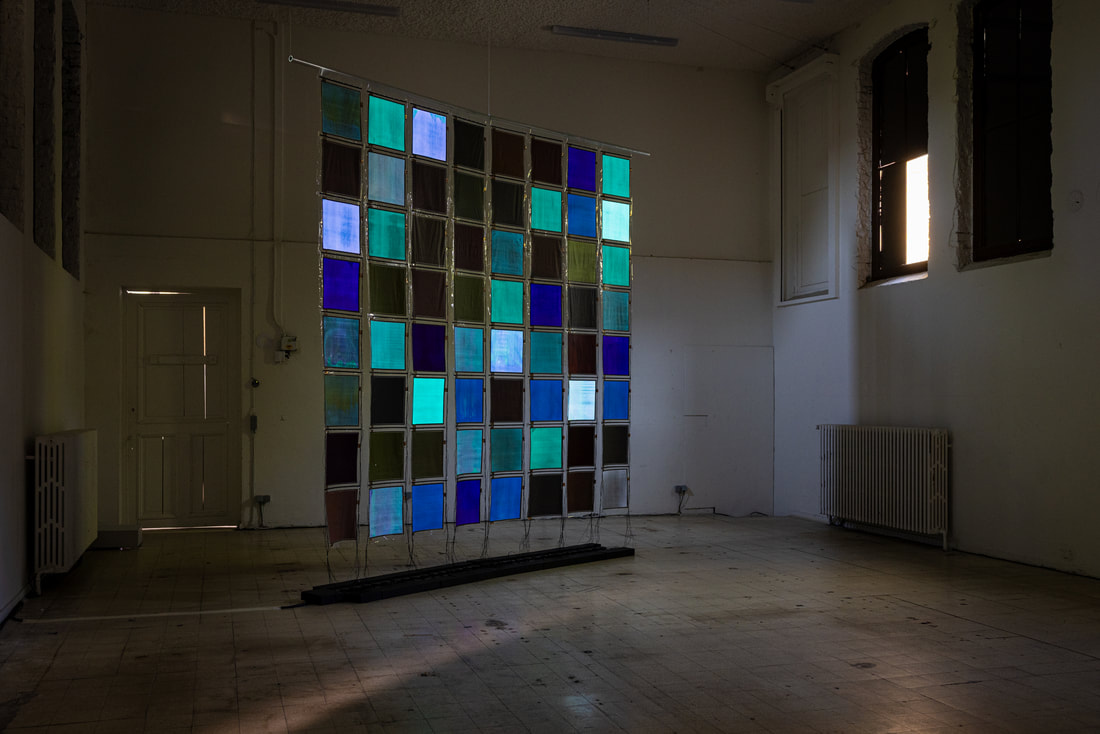
This year’s Rewire marked the sixth edition of Proximity Music, a joint exhibition programme by Rewire and iii, exploring the intersections of music, architecture, technology, ritual, and play through immersive, multisensory installations. Running from 9 to 12 April, this year’s programme – Proximity Music: The Ongoing Hum – took place across multiple venues in The Hague’s city centre, and featured newly commissioned and adapted works by multidisciplinary artists.
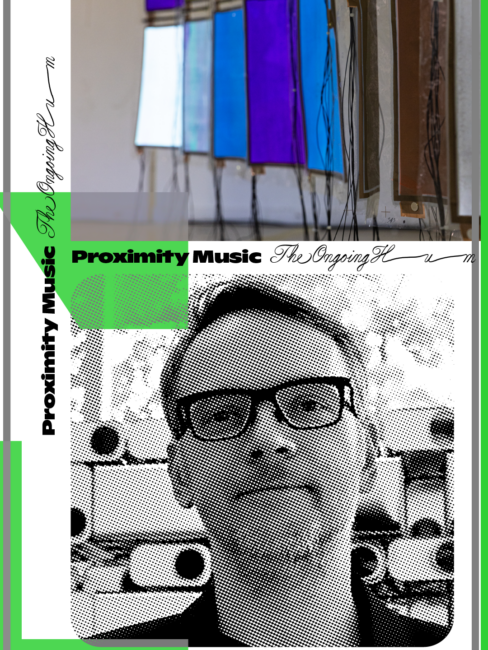
Proximity Music: The Ongoing Hum focuses on attuning to the seemingly inaudible rhythms, vibrations, and radiations that coexist in our environment. The exhibition brought together diverse instruments and compositions that stimulate new ways of perceiving our everyday surroundings: from tapping into the electricity of cyanobacteria and sensing the heartbeat of strangers to the barely audible frequencies resonating in ceramic vessels and immersion in a hypnotic, humming top soundscape. Tuning into the hidden rhythms of the physical world, this exhibition transforms materials into portals by encouraging listening beyond the ears.
„The installations in The Ongoing Hum emphasise physicality as a vital approach for finding wonder in the seemingly trivial. By taking a deep dive into the characteristics of materials and the knowledge they carry, the works engage the whole body and its relationship to the environment. In doing so, they create moments of pause and sensitivity. In a time shaped by instant gratification, digital polarisation, and the numbing effects of the screen, these works ask for slowness, attentiveness, and physical presence – positioning embodied listening as an act of connection and quiet resistance,“ says the organizers.
On this occasion, we conducted an email interview with one of the artists, Aernoudt Jacobs
You mention translating electromagnetic activity into „artificial voices.“ How do you decide on the „timbre“ or „personality“ of these voices? Are they meant to sound human, or do they retain a mechanical, alien quality to reflect their source?
At the moment, during Proximity/Rewire, we work with 5 voice models. One of these voice models is created from our own voice recordings. In the future, Humming the Ubique will evolve to using only our own voice models. But it is an extensive method, and it takes a lot of time to process. Since we now work with different models for the translation process. It mostly depends on the type and sonic input we get from the electromagnetic waves. It is a kind of match-making process, but more importantly, a mimicking process. We are approaching it holistically in the sense that we mostly use all the models together for each location. For me, it does not need to sound either human or alien, but it will sound at times disembodied, alienating, and human.
Why specifically 64 fields? Is there a mathematical or acoustic relationship between the frequency of the electromagnetic waves and the specific hues generated through the foils?
The size of the installation and number of foils depend mostly on the dialogue of the work with the architectural and acoustic properties of the space. When a location for the installation is known, we work on a proposal that fits the space. The work is totally modular and can have different sizes and shapes, so a space with a different size will get a different grid arrangement. It could be just one line of many fields, or just one or two foils to put it extremely. Each panel is screen printed, and because of our individual approach to printing and coloring, every panel is unique in color, blend, and texture. The composition, the sounds, and consequently the intensity and illumination are also treated individually.
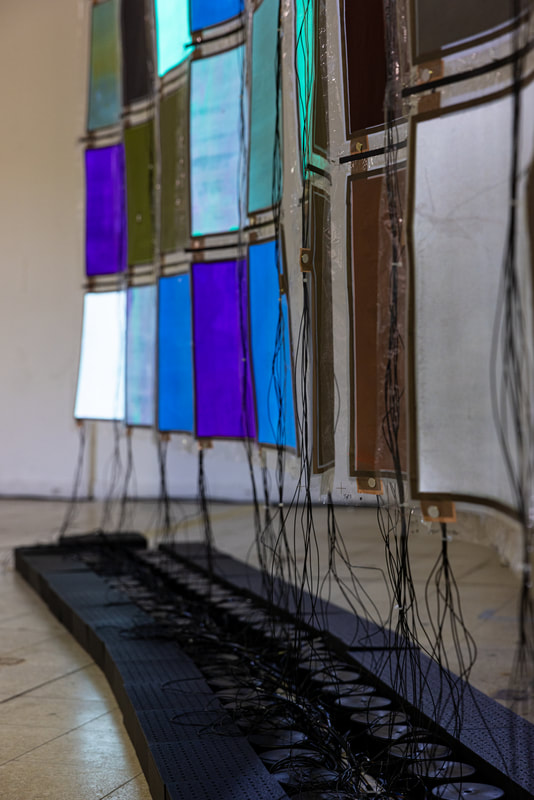
You use „wafer-thin foils“ to create this mosaic. What led you to choose this specific material for visualizing the invisible, and how does its physical fragility play into the theme of the installation?
Extensive research was conducted with various individuals and partners regarding the use of the foils. Initially, the project focused on using piezoelectric foils with screen printing techniques to expand the scope of a loudspeaker. What interested me in these foils is their distinctive plasticity and fragility. It is like a sheet of paper; you can do anything with it, and its form will directly influence how sound will be propagated and perceived. With ‚plasticity‘ I refer both to a potential for concepts and ideas about sound, and to a potential for three-dimensional sound creation.
Unexpectedly, while collaborating with engineers from the University of Hasselt, we found that these foils could also serve as a light source. My previous work with these foils dates back to 2009, in the Permafrost installation, where they were used solely as microphone and speaker elements that amplify the freezing and melting process of water. The inspiration behind making the intangible both audible and visible relates to bridging the gap between the invisible and inaudible spectra of waves, translating them into voices, and returning the vocal energies back into the electromagnetic fields of light and colors that can be perceived.
You’ve stated that these phenomena speak in a register we can understand „instinctively.“ Since these forces are naturally imperceptible, how do you define an instinctive reaction to them? Is it an emotional response or a physiological one?
It is both, I think the voice encompasses both emotion and physicality; they cannot be separated. Hearing involves a physical process, as sound waves hit our eardrum, and speaking is inherently physical as well. From birth, we are attuned to human voices—our relationships and ability to interpret emotions begin with listening. We fall asleep hearing voices and use our own voices to share feelings. Our hearing is optimized for the voice range; hearing tests are primarily focused on this spectrum. In this installation, I have chosen the voice because it is a sound intimately familiar and personal to us.
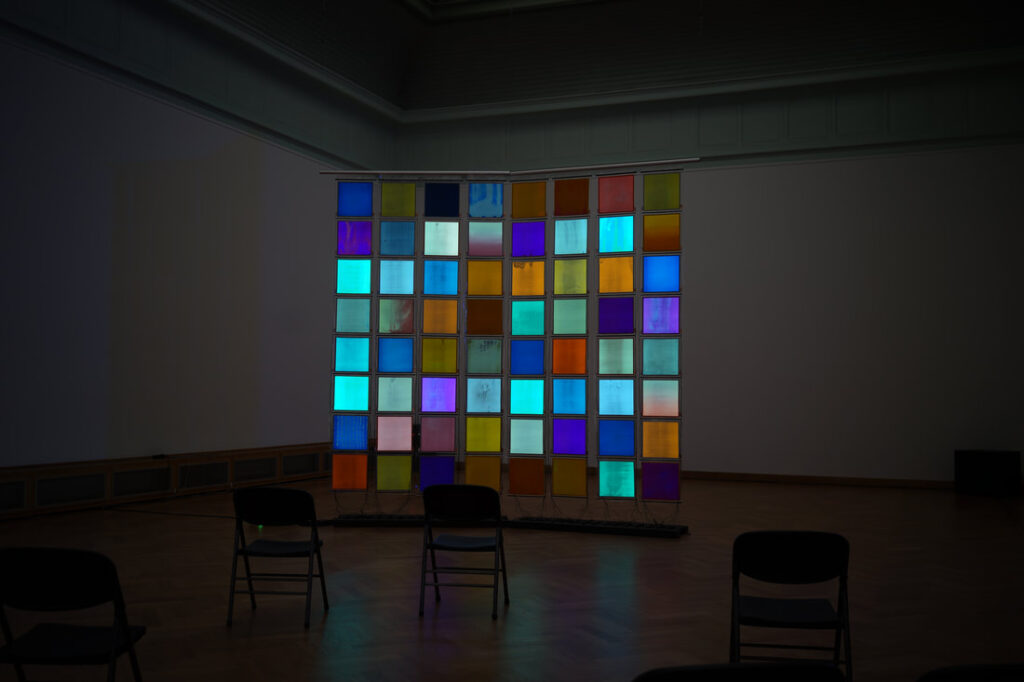
Your work investigates the „observer’s scope of perception.“ Is your goal to expand that scope permanently, or to create a temporary „glitch“ in how we usually process the world? How do you feel about this?
For a brief moment, the work can introduce a temporary displacement. With my architectural and sonic background in mind, I would describe it as a temporary and alternative vantage point. Not something we can inhabit, but something we can pass through. The world seems to speak differently, then returns to its usual opacity. What remains is not the dimension itself, but the memory or the experience that it was there. Through translation, imperceptible phenomena become momentarily present, but only as a constructed layer that appears and disappears.
The installation records activity from „the city to outer space.“ How much does the specific location (in this case, the Rewire Festival) change the output?
For each presentation of Humming the Ubique, I seek locations that reflect its identity. For Proximity Music/Rewire, I recorded at Meijendel, which is a vast dune area half an hour away from the city. I chose it because for me, The Hague’s beach area feels like a horizontal extension of the city, and Meijendel is as distant as possible from Den Haag’s electric grids and urban activities. The other recording took place in real time within the exhibition space itself, connecting directly to the immediate electromagnetic fields generated by visitors and the surrounding urban environment.
You are primarily working with sound as a medium. Do you view the visual elements of this installation as a secondary element for the sound part, or are they equal partners in the sensory experience?
They are treated with particular attention.
Electromagnetic waves are often considered purely as „noise“ in a technical sense. At what point does this ambient noise become „composition“ in your eyes?
I suppose it becomes a composition once the EM waves are intentionally manipulated and reimagined, gaining a new context in the process. In this sense, the concept of composition articulates the transformations of phenomena typically regarded as noise. Shaping electromagnetic waves—adjusting their properties, patterns, or interactions—they cease to be background noise and instead become elements of something new.
–
Questions: Krištof Budke / You can follow Aernoudt Jacob on Instagram
Pridaj komentár