
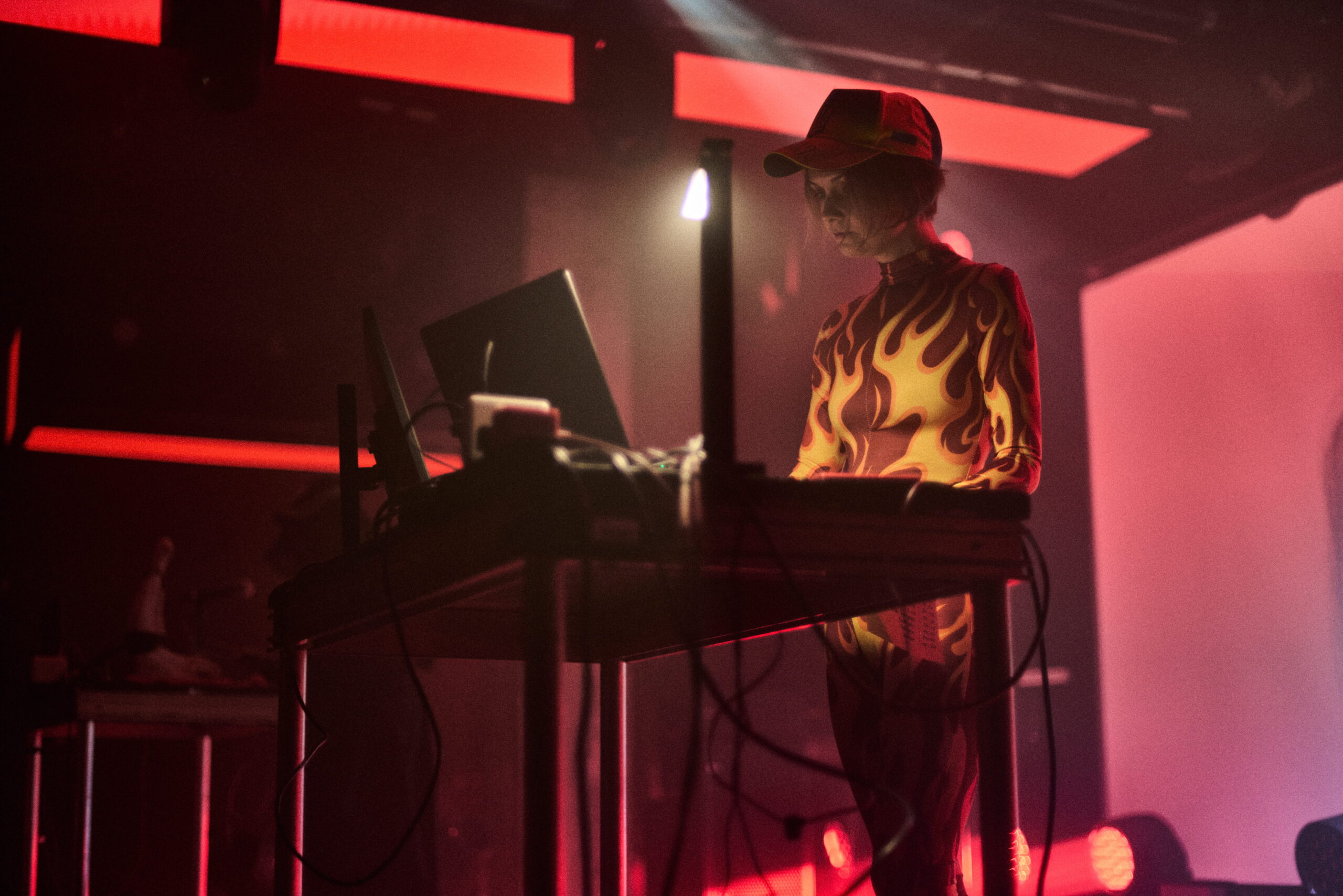
Intense washes of strobing red flashed before my eyes as I stood in the crowd, blinking out haunting, futuristic doubles, like demonic spirits guarding the entrance to an endless psychedelic void. On stage left was a strange figure shrouded in thick layers of black lace spilling from a spiked cap, and to the right, a shadowy outline in a hat and printed bodysuit. Each stood before tables laden with electronics. As if connecting to some unseen realm, the veiled figure scraped a pair of sticks across the toothed jaw of an animal, bound in a small chain. The live projections intensified as the sound shifted into precise modulations of sub-bass frequencies that took hold of my cheekbones, then settled into the cartilage of my nose for several minutes.
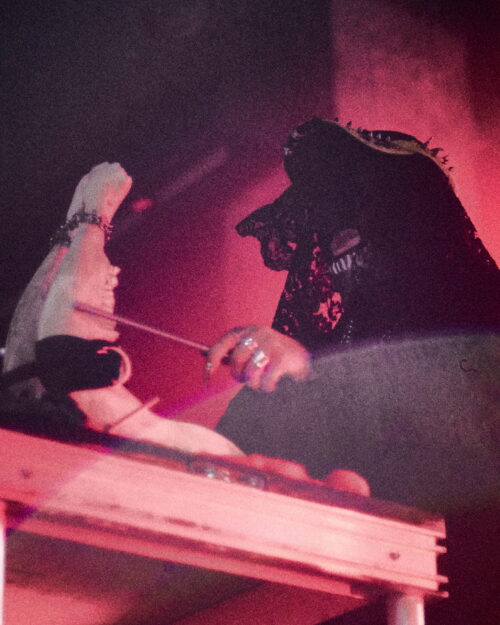
Foto Credit: Rodolfo Rueda [Instagram: rod0lfo.rueda]
The night’s offerings spanned the Satosphère dome upstairs, which showcased live spatial A/V performances, and the Espace SAT downstairs, where BRUXISMO appeared on a searing lineup exploring the darker extremes of electronic performance, alongside Evicshen, Violent Magic Orchestra, and Cry (Relaxer & Kilbourne). It was five days into the festival of forward-thinking electronic music and digital visual art, and an international nexus for adventurous music devotees. I was still riding the high of a lunar eclipse seen from the sidewalk outside the SAT the night before, like a prelude of sorts to the potent energies unleashed in BRUXISMO.
In the month following the premiere, I had the chance to correspond with Max and Anastasiia about the creative processes and ideas behind the immersive piece I witnessed. Both based in Vancouver and hailing from Mexico and Ukraine respectively, the collaborators expanded on the themes of magic, folklore and ritualism in their surreal and gestural piece, a dark fairytale of atmospheric horror, spiritual rupture and dystopian surveillance realities.
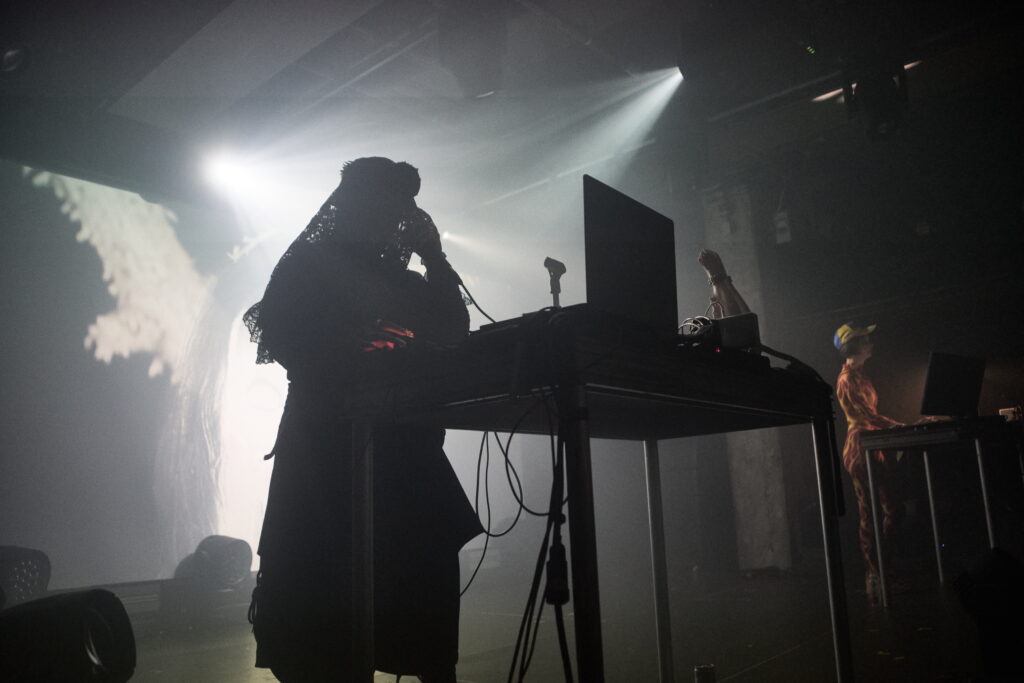
Foto Credit: Rodolfo Rueda [Instagram: rod0lfo.rueda]
The title BRUXISMO holds a lot of tension: dread, fear, and gnashing of the teeth. Sonically, it’s dark and shapeshifting, with waves of menacing low frequencies repeatedly washing over the audience, and the visuals are intricate and hypnotic. What’s the story behind the title, and how did these concepts work their way into the piece?
Max: That’s exactly what I loved about that title and what it conveys: it literally is about holding tension and when that comes to a breaking point, both from a personal and collective standpoint. How much can we hold in as individuals and collectively before things shatter from pressure, or when two contradictions reach their most extreme results?
BRUXISMO came to me as a title around two years ago. It stems from a condition I have called bruxism. This means, in my case, involuntarily clenching my teeth 24/7. No doctor or dentist had thought about telling me in 4 years of dealing with it that this could be a long-term chronic issue or that it had a name. One day it was particularly bad and I was losing my mind, so I decided to go into an acupuncture clinic and ask if they happened to treat it. They did, and told me the name.
I researched it, and as a Spanish speaker first, I thought the name went really hard. I also couldn’t help but notice its proximity to the word Bruje (mage) or Brujeria (magic/witchcraft). It planted the seed of an important intersection in my work: a new angle that I wanted to explore in relation to my identity, culture and wounds caused personally by the process of immigration, and also the spiritual wounds of colonialism and how that ends up affecting the flesh. Since then, I set my mind to transmute this into a sonic project and specifically the name for my debut EP or album.
In a more visceral way, the sounds of flesh and bones are present throughout this piece: breaking, being torn apart. Some samples were taken in the process of developing the bone instrument, the instrument being processed through Ableton. I even bought some meat one day to do some Foley work, which was pretty fun. There are also lots of vocal pads, breath/sighs, voice processed by a vocoder, and even some electronic sounds that seem to be voices but are not. So these are either custom samples/lyrics made with my voice and processed, or instruments/electronic accidents that sound like voices, which I used to represent the attempts to mimic humanity in our tech dystopia. I have a very animistic belief that carries over to sound, so I work a song or sound until I feel like it’s breathing.
I ended up researching a lot about techniques, frequencies, and even scales that are used in scoring horror films – that’s one of my biggest dreams, so if someone wants to help me make that a reality, HMU! Films, particularly horror/thriller films, are some of the most important sources of inspiration for both El Ángel Exterminador and BRUXISMO, both sonically and visually. The main engines of tension and suspense are tools that I like to use in my sound and really became central in the compositions. I wanted to get under people’s skin. There were sounds which were outright horrific or abrasive, frequencies I hid on purpose, and musical tools that I used to mess with the audience psychologically to create certain emotions and reactions.
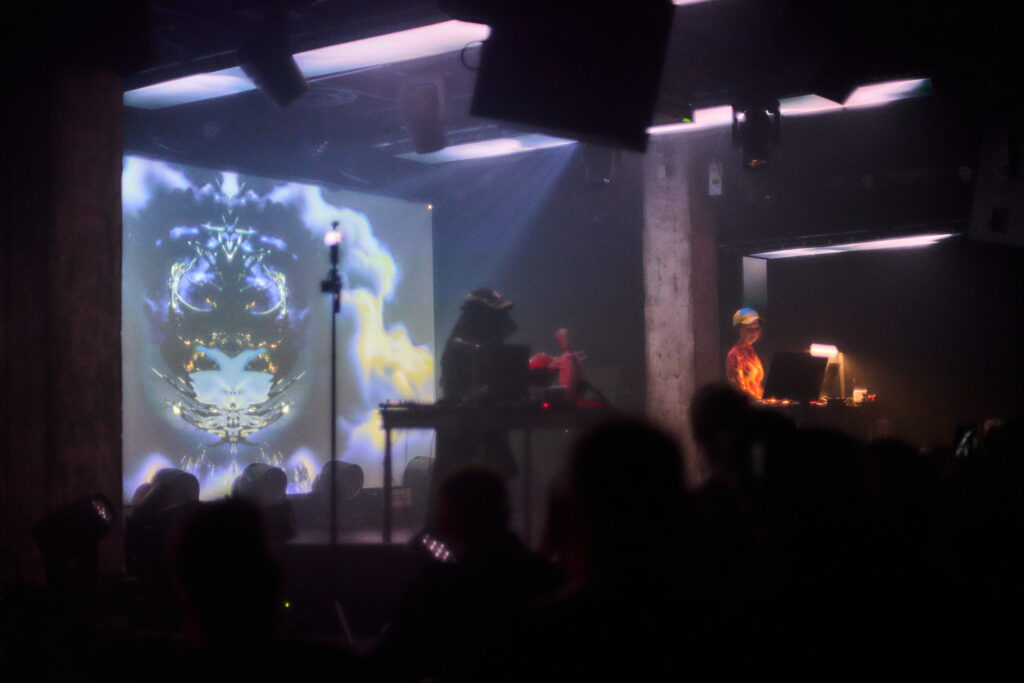
Foto Credit: Rodolfo Rueda [Instagram: rod0lfo.rueda]
I sometimes just sat with a drone or sound until I made sure that my jaw was tense or that I was getting shivers down my spine. Bass carries a lot of this burden, specifically sub-bass: things you don’t necessarily hear, but feel in your body. Knowing this was going to be performed on a pretty big sound system, I really wanted to use that tool and not waste the opportunity. The same was done with positive emotions, but of course those sections were more scarce and in that sense I wanted them to feel precious.
I’m also an animator, so I played a lot with foreshadowing as a tool as well as anticipation. Sometimes there would be clues to psychologically communicate there was going to be a change, or sometimes leaving that out for a sonic jump scare.
Speaking of which, Max, you describe your musical style as “thriller electronics”. What are some of the emotional energies and sonic materials that go into this sound?
Max: Horror/thriller films make up an important part of what inspires this project, but there’s a lot that goes into it: magic, gender, spirituality, and politics tend to be at the core of the energies.
The world we live in is fucked up and it’s also beautiful. I like to use music as the lens to comprehend worldly and bodily contradictions. I was born in Mexico, I am from Latin America, and I like to interpret and sublimate both the horrors of our history and present as well as honour the beauty and resilience of our cultures. Sometimes through instruments, sometimes through genres, or sometimes just from a feeling. But it always comes down to these tensions and contrast between both.
For example: The first song in BRUXISMO is my interpretation to “Prelude to Columbus“, a microtonal composition by Mexican legend Julian Carrillo, which is a haunting rendition of the tension before the conquest. I wanted to ground this composition in a way that felt timeless, so I kept it restrained to using Pre-Hispanic instruments. I used physical wind instruments I own as well as a digital plugin called Nagual, which is a reactive polyphonic instrument built from rare Pre-Hispanic ceremonial sources, so it’s an incredible library.
The arrival of the Spaniards is signaled during a field recording with the ocean, the sound of horses, and the foreshadowing of the horror to come through a Death Whistle. There’s an overture to the next part of the first act marked by a cover I made of “Ay Que Triste Que Vengo!” from Juan de Encina, a song which was popular in Spain during the time of the fall of Tenochtitlan. I translated a notation for two flutes into MIDI and juxtaposed it with the meat and bone Foley to signify the painful birth of the modern history of the region. The next track starts as a more traditional Tribal Prehispánico which becomes hardcore (saludos a Naca worldwide, las madres), distorted and noisy by the end to signify the anger boiling over from the last 500 years, like an intergenerational scream.
In a broader sense, for a live show, the main outcome I am looking for is that the audience feels like they’ve been put under a trance or spell; it’s my most important KPI, if you will. I want to generate an atmosphere of unease and mystery, create moments of tension and sublime, and also to cast gender vengeance whenever possible through any vehicle necessary.
The BRUXISMO visuals are vivid and intense – I especially remember the visceral strobing red. Anastasiia, how do movement and color play into a live A/V setting?
Anastasiia: Color and movement are really important to me. I wanted to move through very different emotional spaces. Sometimes the visuals are dark, alive, trippy, and almost foggy, like the forest, with lots of layers and sophisticated movement. And then suddenly everything breaks into something very sharp and minimal: a sword against a red surface. I’m happy you remember that strobing red, because this sudden change in visual language was very intentional. It’s almost like waking up from a strange dream and suddenly seeing one very clear message.
I’m very interested in how a symbol or color can carry a surprisingly condensed meaning without having to explain everything. This approach has been used beautifully in cinema. I love The Color of Pomegranates by Sergei Parajanov, where some scenes feel almost more like paintings than cinema. There can be a boy surrounded by books covering the whole space, with the wind simply moving the pages. We don’t need to watch him literally reading to understand that he is a passionate reader.
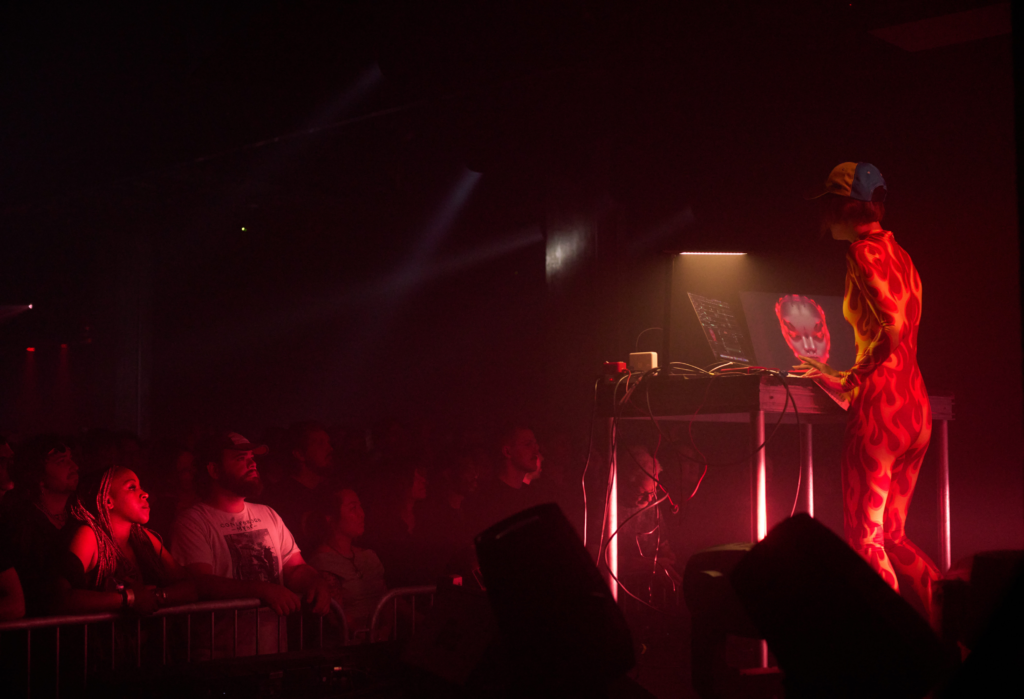
Foto Credit: Rodolfo Rueda [Instagram: rod0lfo.rueda]
Anastasiia, can you tell us more about how folklore and mythology influenced your work in the making of BRUXISMO?
Anastasiia: Coming from a theatre background, I’m drawn to the space where different art forms meet: performance, scenography, sound, light, and visual storytelling, because something genuinely new can emerge there that none of them could produce on their own. I brought into this collaboration research I had been developing for several years into magic fairy tales: their recurring structures, their symbolic language, and what they carry that more literal storytelling cannot.
What fascinated me is that the fairy tale isn’t specific to one culture or place. Researchers in folklore and comparative mythology have shown that the same deep structures and symbols appear independently across vastly different traditions, even in cultures with no contact between them. This tells us something important: these stories speak to something fundamental in human experience.
My research led me to Clarissa Pinkola Estés and her book Women Who Run with the Wolves, particularly her interpretation of The Handless Maiden, a tale that moves through seven stages of psychological transformation. I proposed using these stages as a shared dramaturgical structure for the performance. Within that structure, Max developed their sonic narrative and I developed a visual one: digital characters, symbolic imagery, transformations of virtual environments. The two narratives were brought into dialogue through specific points of connection and through the live performance itself.
For me, fairy tales are not a soft or nostalgic subject. They hold fear, loss, transformation, and the possibility of regaining agency. Folklore carries something even more personal: it connects me to Ukrainian cultural memory, at a time when places, heritage, communities, and lives are being destroyed. It is also a way to preserve a connection to something being violently altered or lost.
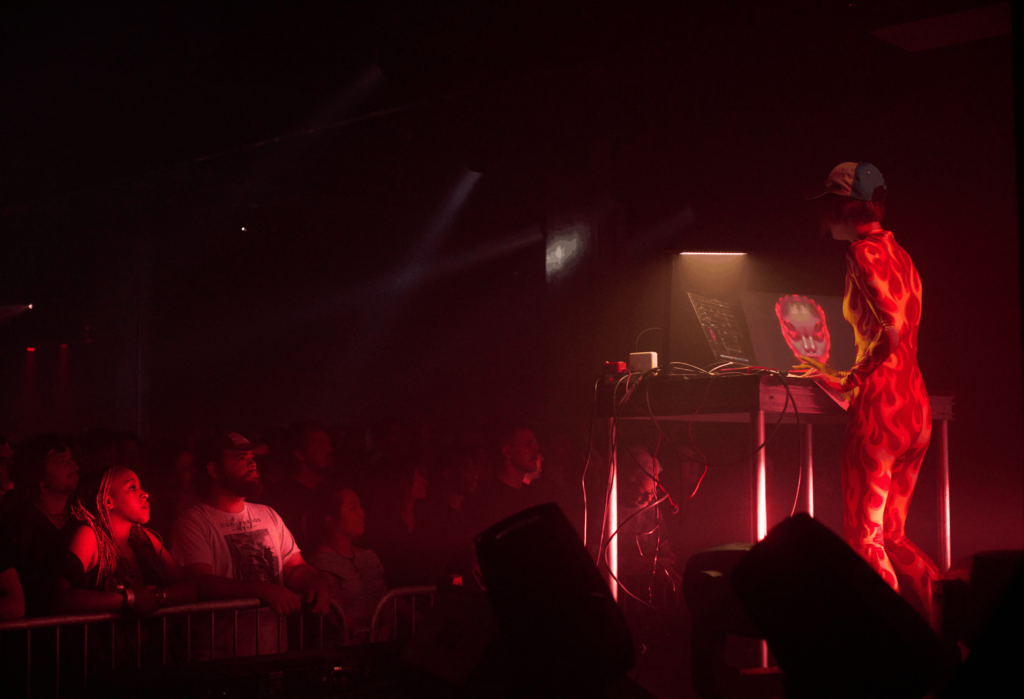
Foto Credit: Rodolfo Rueda [Instagram: rod0lfo.rueda]
Anastasiia: Honestly, every project is unique, and I really enjoy finding a new approach each time. For example, working on the project for MUTEK was different from my VJ practice. It’s exactly same difference between DJing and performing your own composition. Both are fun. With DJing, you’re selecting, mixing, and reacting with existing material in real time. With your own composition, you’ve built the material and its structure yourself, and then you bring it to life in the performance.
I love VJing because there is this freestyle element, and sometimes completely new ideas appear through improvisation. With BRUXISMO, I wanted to challenge myself in another way. All the visual material was created specifically for the project based on the seven stages of the fairy-tale narrative, and I built a quite detailed score that had 25 video changes during 45 minutes of performance—it’s a LOT! I had different visual motifs appearing at very precise moments—literally following timecodes. It took quite a long time to arrange because I wanted the visuals to make sense both with the development of the story and with what was happening sonically.
But I also didn’t want it to feel only fixed. The visual elements were audio-reactive, so the sound coming in real time into software was affecting effects programmed by me and things like speed, color, or other deformers in Resolume. I really like this because it creates a living connection between sound and image.
So during the performance, I’m doing both things at once: following quite precise timing while also reacting to what is happening live. It requires a ridiculous amount of concentration! At some point, I realized I felt almost like I was playing a score in an orchestra—except my instrument is this giant composition of moving scenes, characters, effects, colors, and transitions.
Max, can you tell us more about your creative persona El Ángel Exterminador? In your live appearances, the face is often hidden: in BRUXISMO, it’s with a thick veil of black lace. As an audience member, it creates a bit of uneasiness: you might see us, but we can’t fully see you. The depersonification takes us into a surreal space. How did the El Ángel Exterminador concept come about, and what are its key symbolic elements?
Max: To start from the beginning, El Ángel Exterminador (1962) is a surrealist black-and-white film by Luis Buñuel shot in Mexico using actors from the Mexican Golden Age of Cinema. In simple terms, the story is about a group of wealthy people who gather at a lavish party, but they can’t leave the room and all of their workers have mysteriously decided to leave as well, so chaos ensues when left to their own devices. We get to see the savage nature of the so-called “noble” and the darkness behind these social structures. It’s a bit like “Triangle of Sadness” [Dir. Ruben Östlund, 2022], but 60 years before.
I am a Mexican person raised Catholic, so I both have a soft spot for religious and apocalyptic imagery and a need to subvert it. In my time as [earlier solo project] Goo and definitely for this project, music has been a way for me to talk about gender, necropolitics, body horror, magic and spirituality. So it felt right to step into this new project with a name that encapsulates this, but that is also sharp and foreboding and ties into my love of film and surrealist artistic framework. This project was born in an era of little visibility for Latine electronic music in Vancouver, so I also liked that it took up a lot of space visually on flyers.
Talking about visibility, there are many reasons why I love being veiled/masked. One of them is the effectiveness in removing people’s conscious/subconscious ability to pre-judge based on preconceived notions, like how human face recognition detection will draw on biases. Confronting people with an active unknown and the inherent tension and unease it causes as a baseline is something I like to play with.
I like the music to speak for itself. I also like the freedom it allows in not being perceived as a certain gender. That, paired with the lower octave voice I use (inspired by Mexican cumbias rebajadas), is ultimately the most extreme version of my gender euphoria.
The other side of it, aside from rejecting hypervisibility and surveillance, is the dance between my strong faith in the Zapatista political project in Mexico and their symbolic covering of their face to both symbolize that behind the mask could be anyone and para que nos vean, nos tapamos (Eng. „so they can see us, we cover ourselves“), crossed with [Martinican writer] Édouard Glissant’s “right to opacity” in Poetics of Relation. He speaks about how the West demands transparency to be accepted, reducing complex identities in the process, the decolonial lens of refusing this reduction, and the right to remain ungraspable and complex.
Mixed with Mexican and religious folklore and imagery of bones, veils, La Santa Muerte, holy/unholy, my penchant for esoteric symbols and theatrics and wanting to allow others to experience a little mystery in their lives are some of the ways in which this entity comes alive. Not to mention masks are some of the most universal tools for storytelling in humanity.
Onstage at MUTEK, you played a ritual instrument that looked to be made from the jaw and teeth of an animal, wrapped in chains. What is the story behind this mysterious instrument, and what sounds were you able to conjure from it?
Max: I had been wanting to build an instrument for the longest time and then came an open call from Currently at the end of 2025. It was perfect timing because since I was part of the MUTEK Incubator program and attended last year, I had been thinking of the symbols for BRUXISMO like bones, jaws, metal, and rituals, and what I would like to do for a live show presented at MUTEK. It made sense to pitch either way whether I got the Currently mentorship program or not to have an instrument I could use that really anchored and physically symbolized the central crux of this project.
I was able to be part of this peer mentorship with Anju Singh – someone I really admire, and I’m forever grateful to her for the push and support of my musical development – and Roxanne Nesbitt, who I also admire so much and makes so many rad projects. The process started with the idea of something made out of bones, starting with research of percussive instruments like Quijada (Latin America) and Huessera (Spain). Then experimentation of how to prepare bones, which was a little too time consuming and smelly, but I had a lot of fun doing this very visceral activity of removing flesh, boiling, repeating, thinking about death, drying bones, and then experimenting with how they sounded before committing to a final piece.
In the end, I found someone who sells roadkill bones in Ontario and they had these 4 cow jaws that became the central element. Together and mirrored, they seem (to me) like a beautiful sculpture reminiscent of Art Nouveau. I wanted to contrast with my industrial tendencies, so I went to Home Depot and got all these metal rods, flys and bolts to secure them together. Since bone is porous, it actually makes a really good conductor for sound, so I used a contact mic to pick up on sounds instead of a dynamic mic, which makes life easier to avoid feedback, and then processing live through Ableton, so it means it could sound like anything.
For portability, I only brought one set of jaws to MUTEK, and using the ribbed metal rods I was able to conjure an interesting roaming drone during the first act. Because of its malleability through processing, it made a great shapeshifting sound tool to create textures in the compositions. I’d like to continue working with it and transforming it into things like a more string-like instrument, continue its percussive uses, and see what other lives it can live. Thank you to the cows that continue to live on in these; it’s honestly really comforting to know that these once-living creatures still roam, even if in this unorthodox configuration.
The live projections in BRUXISMO layered and morphed through several recurring motifs, including spiderwebs, winged insects, and haunting floating faces that gave the feel of a menacing, demonic vibe or eerie doppelgängers. What is this nocturnal place, and who are the strange doubles that inhabit it?
Anastasiia: You’ve picked up on something central to this visual world: repetition and transformation.
I was interested in repetition as an element of ritual and in how it can create a trance-like state. Some parts of the performance are built from loops that gradually change and mutate into different states. I was also interested in creating a dreamlike atmosphere, giving the sensation of being in a dream, where all the elements seem somehow alive and places and objects carry symbolic meaning.
One of my questions was how to tell a fairy tale through a digital visual narrative, without actors performing it on a physical stage. I created a 3D protagonist but decided to develop her in several different states or modes. (I guess a good illustration of this idea is Sailor Moon: in the anime, she is a regular schoolgirl, but also a warrior, and then she has a different look).
My idea for creating a narrative with a digital character was to treat her almost as a puppet that I could place in different environments, but also as a theatrical figure whose changing masks reveal different aspects of herself. Sometimes she has a very realistic human face, but at other times she turns into a fantastical, dark avatar. This is where the strange doubles come in. They are not necessarily separate inhabitants of this world, but different manifestations of the protagonist. Through a Jungian reading of fairy tales, we can understand the frightening figures a hero encounters as expressions of their own shadow—parts of themselves they may not yet recognize or accept. I was interested in making that inner confrontation visible.
The eerie, sometimes shadow-laden atmosphere also comes directly from my fascination with fairy tales. We often associate them with childhood, yet they are full of violence, fear, and disturbing encounters. I wanted to preserve that unsettling quality rather than soften it.
The forest is especially important in this narrative. Across many fairy tales, entering the forest marks a departure from the familiar world. I interpret it as a journey into the unconscious, toward dreams, emotions, and things we cannot easily express in words. It takes courage to enter that space and encounter what is hidden there. The strange creatures and doubles can be understood as part of this journey: they confront the protagonist, test her, and perhaps teach her something about herself.
Our story draws on The Handless Maiden, in which the protagonist loses her hands and eventually grows them back (sorry for the spoiler :)). For me, the loss of hands is a powerful image of losing independence and the ability to act in the world. Her journey is one of transformation, and the return of her hands becomes a visual expression of renewed agency and a changed sense of self. That is why hands become so important toward the end of the performance, when their movement becomes majestic and calm.
Anastasiia, you’ve worked on VR projects for varied environments like theatrical stages and media art installations. Are there different considerations between creating a VR piece for a live stage performance vs. a media art installation?
Anastasiia: Yes, very different. When I create a VR installation, it’s this fantastic—I would say truly magical—possibility of letting the audience experience digital art in a very physical way. But physical without the usual limits. My body can be male, female, or a non-human plant form. Gravity can exist, but it doesn’t really have to. We can fly, like in dreams. Actually, I often dream that when I encounter something dangerous, I simply fly above it to be safe. In VR, luckily, I fly purely for pleasure.
Another thing about VR art installations is that VR wasn’t really meant to be an art medium. You know, like Nam June Paik used TV in his artworks when TV wasn’t considered to be used in art :). I started questioning how VR and game engines come with so many rules. They were largely developed for the gaming industry, with its conventions around bodies, gender, narrative, and even what you are allowed to do. A wall is supposed to be solid; your body is supposed to have a certain form; you are supposed to follow the instructions—or die. I became interested in deconstructing them— discovering what is normally hidden. Especially in earlier game culture, there were also quite conservative ideas around gender: hyper-feminine female characters and hyper-masculine male characters. For me, artists entering these technologies opened up a rhizomatic space, where we can question these conventions, bring in new meanings, and imagine completely different ways of being.
In theatre, though, VR becomes much more complicated—and genuinely fun—because suddenly there are two realities happening at once. The actor is inside the virtual world, while the audience sees both the physical actor and a projection of an avatar in VR. I started thinking about the virtual environment almost like a strange cinema set, where completely different locations can exist next to each other, a little as they do in our dreams. But now you also have a virtual camera operator—and theatre actors are definitely not used to performing for a digital camera. So this creates a completely new kind of rehearsal.
I love this translation between theatre and virtual space. The wings become hidden digital areas, costumes become avatars, scenography can transform instantly, and an actor can suddenly become enormous or tiny. Theatre has always been about imaginary becoming real, and VR just gives us some strangely alive new ways to play with it.
–
NOTES
- Anastasiia: “Through my research of magic fairy tales, I came across the work of Clarissa Pinkola Estés, particularly her book Women Who Run with the Wolves: Myths and Stories of the Wild Woman Archetype. […] Estés’s interpretation of The Handless Maiden describes seven stages of psychological transformation.”
–
Text: Vesper Guthrie aka spectral.type
Pridaj komentár