
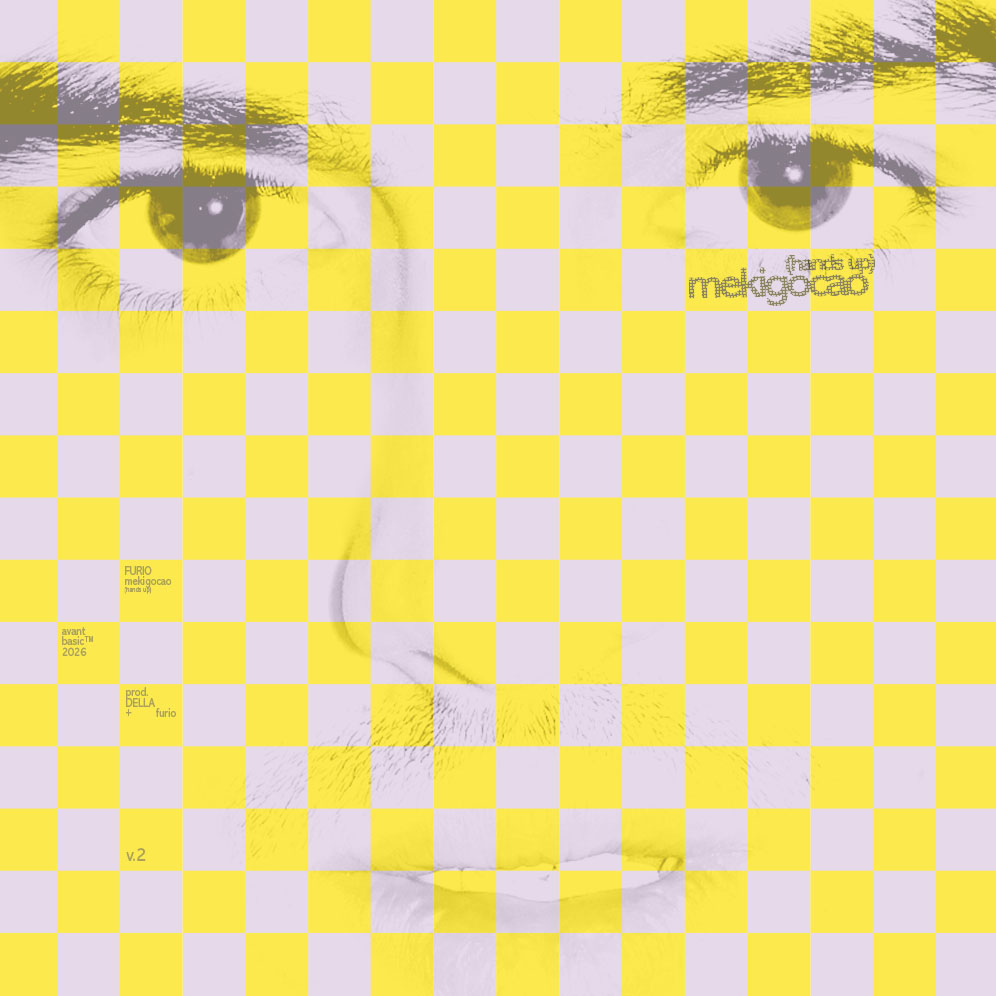
FURIO was born Federico José Güiraldes in 1992, and almost immediately, the obsessions began. As a child: Lego, A*Teens, Digimon. During adolescence came pop, and with it a monastic dedication: hours of Wikipedia, VH1 documentaries, and entire nights dancing alone in his room in the dark, from Pixies to M.I.A., from Daddy Yankee to Madonna.
During high school, he formed his first musical project with Garoto3000, which later became DEFENSA, a duo that explored an unorthodox crossover between pop, electronic and reggaeton, released music through the avant-garde Mexican label N.A.A.F.I. and was selected by A. G. Cook – founder of the iconic British label PC Music and executive producer of Charli XCX’s latest albums – for his “Perfect Pop” Playlist.
Now you can read our interview with FURIO and listen to Swine Premiere of „mekigocao ⁽ʰᵃⁿᵈˢ ᵘᵖ⁾“
In the press release, it’s written: „hours of Wikipedia, VH1 documentaries and entire nights dancing alone in his room in the dark, from Pixies to M.I.A., from Daddy Yankee to Madonna.“ I love this, it can be really heard from your music, it’s a complex collage of all of these influences. Do you feel this EP is like this – an ode to all your musical heroes?
I don’t think this EP specifically… I guess all the music I’ve made is an ode to my heroes. I’ve metabolized so much music over the years that those influences inevitably show up, sometimes in really small ways and sometimes in much more obvious ones. Sometimes it’s a direct reference, but more often it’s just a tiny detail that stayed with me. I’ve always been obsessive about music, so after a while, all those things stop feeling separate. Pixies, M.I.A., Daddy Yankee, Madonna… they all end up living in the same place in your head. They all end up living in the same place in your head. And to me, they all share a certain intensity. They all feel themselves completely. In the end, I guess that’s what I want to achieve with my music too.
What about your upcoming project? What can you tell us about it, about the process, what it will sound like? Was it recorded in Barcelona?
The project is called BOYEUR, but the installment I’m releasing next month is an EP called BOY2. It’s big, bright, eclectic, and probably the best thing I’ve made so far. I think I’m letting myself follow my instincts more than ever. There are moments that feel very intimate and others that are almost ridiculous, and I’m getting better at not trying to resolve those contradictions. For a long time, I was very focused on making „the album“, something definitive, perfectly structured, where every piece fit exactly where it was supposed to. Now I’m much more excited by surprise. Starting somewhere and ending up somewhere else. So instead of releasing everything at once, I’m putting it out in pieces and letting it reveal itself over time. It was actually made all over the place. One of these songs is over 5 years old. A song that I started in Buenos Aires, but finally makes sense to release now. One of them is a cover that we made with DEFENSA specifically for a show in Mexico in 2020 and have been playing live since, but had never made a proper “studio version”.

You were previously active under the name DEFENSA, which was a really unique intersection between the mainstream and the underground. How do you feel your solo project will change, be different, from DEFENSA?
DEFENSA was a really special project, and honestly, I’m incredibly proud of what we built. Looking back, I think we were doing something that wasn’t really happening in Buenos Aires at the time. There were amazing artists around us, but Juana and I were combining a very specific pop sensibility with what was happening around reggaeton, club music, and internet culture in a way that felt pretty unusual.
We were also two queer kids making music that was extremely romantic, extremely earnest, but also very danceable. I think that combination helped us find a place in the scene and connect with a lot of people. The biggest difference with my solo project isn’t that I’m rejecting any of that. If anything, I’m taking some of those ideas even further. With FURIO, I feel more free to follow contradictions, let things get stranger, softer, brighter, or more fragmented. I think I’m constantly getting closer to making music that reflects how my brain actually works. And I think the biggest lesson I took from DEFENSA is that, at a certain point, everybody seems to have an opinion about how to make a project bigger. Fewer people are interested in protecting the thing that made it interesting in the first place. So these days I’m trying to trust my instincts a little more and spend less time worrying about where something fits.
Are you now based in Barcelona, Spain? How is the city influencing you and your music? Do you feel it has a particularly significant influence on your work?
I’ve been living in Barcelona for a few years now, and it’s become home in a lot of ways. At the same time, I don’t know if my music sounds particularly „Barcelona“ or even particularly „Argentinian“. If anything, it probably feels more native to the internet than to a specific place. Living abroad does something strange to your sense of identity. After a while, you stop feeling entirely from one place, but you don’t completely belong to the new one either. There’s a kind of in-between state that I’ve grown to like.
Barcelona has definitely influenced me as a person. I’ve met incredible people here, built a life here, and had experiences that inevitably end up in the music. But I think what shows up in the songs is less the city itself and more that feeling of existing between different worlds.
From your music and lyrics, particularly, I feel a lot is based on (romantic) relationships. Are relations and conversations something that you draw a lot when writing lyrics?
Definitely. But I don’t think it’s really romance itself that I’m writing about most of the time. What I can’t stop thinking about is how other people shape your reality. A lot of my songs start from very small things: a conversation, a sentence somebody said, a misunderstanding, a voice note, a feeling I can’t quite get rid of. Sometimes a relationship becomes the container for all of that, but I’m usually not trying to tell a story from beginning to end. Most of the time, I’m trying to capture an emotional state or a very specific feeling before it disappears.
And I think that’s why a lot of my songs end up feeling quite personal. They’re usually coming from something that actually happened, even if by the end it’s been transformed into something else.
You were working on Nathy Peluso’s album as a creative director. Is this professional collaboration something that benefits you in your own creative process? Does it influence you, or on the other hand, do you try to separate the creative work for other artists and your own art?
Working with Nathy has changed me a lot, honestly. One of the things I’ve learned from her is that being an artist doesn’t mean disappearing behind a team. She’s still very involved in everything she does. She’s passionate, demanding, incredibly hardworking, and also very transparent about what she likes and what she doesn’t. I’ve learned a lot from seeing that up close.
Something else I’ve noticed is that a great project doesn’t necessarily need a huge team around it. A lot of the time, it’s about finding a small group of people you trust, who understand what you’re trying to do, and building from there. It’s also made me think a lot about performance. Seeing her on stage and seeing the level of commitment she brings to what she does definitely raised my own standards.
At the same time, I try to keep a separation between my work for other artists and my own music. If anything, working so closely with someone else’s vision has helped me understand my own a little better.
What are some of your contemporary artists‘ inspirations? Do you have some artists whom you like or admire, perhaps your friends, who inspire you significantly?
Dani Umpi is one of my favorite lyricists, full stop. I really admire what Matt Montero and Ceretti are doing. There’s something very sincere and very audacious about their work that I find incredibly inspiring. I’ve also been really wowed by what EQ is building. It feels very singular, especially coming out of Buenos Aires. I have a lot of admiration for artists who commit fully to creating their own language. I also love Mabel, MissLupe, Faraonika, Coghlan, Six Sex, and a lot of the artists that are making Buenos Aires one of the most exciting cities for music right now. And honestly, beyond individual artists, I’m inspired by the scene itself. Parties like Pop Hereje, Popperazo, and A-MIX feel really special to me. They’re creating queer spaces that don’t feel theoretical or overly self-conscious. They’re just being lived in an honest and fun way. I also see a kind of reclamation of the ridiculous and the absurd. Maybe that’s what happens when reality itself starts feeling a little absurd. A lot of what I wished existed ten years ago is happening right now, and it’s really lovely to witness.
–
( You can follow Furio on Instagram )
Pridaj komentár