
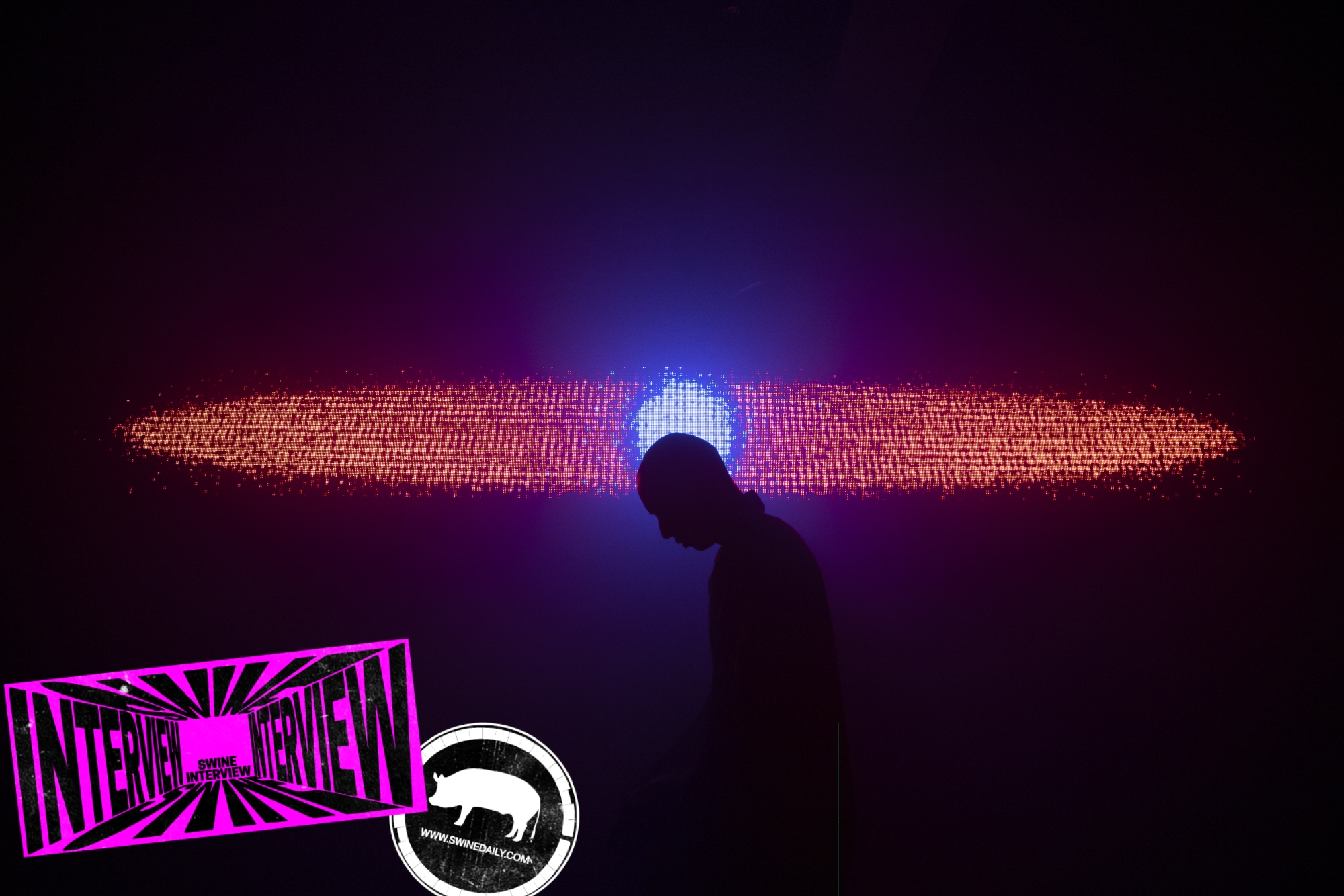
In the process of scrolling through the various social media sites, I’m looking for inspiration, or just casually researching „what is going on“ in the art world, in the music world, and in general. In recent weeks, my algorithm has been selecting a lot of various stage designs, light installations, and art exhibitions. Usually, it doesn’t strike my attention significantly. Until I came across the light installations of aka_chang. His bold light reflections in the water and various laser compositions caught my attention. His work is bold, minimalist, but very effective.
aka_chang was born in 1979 in Taipei. He’s a Taiwanese media artist who specializes in using light to create spectacular scenes. Early in his career, he entered the field of visual arts as a VJ. As he grew older, it became apparent to him that even the most complex and dazzling images could be reduced to a single light source. This realization led to experimentation with various luminous materials and smoke, logically replicating and combining light arrays in symmetrical or asymmetrical patterns. Observations were made on their textures, their relationships with the medium, and their potential impact on human perception, establishing three-dimensional light and sound structures connected to time, space, sound, and people. Currently, his art represents an ongoing process of reduction.
His work “Rainforest of Oslo” was selected for the Taipei Digital Art Awards (2008). The audiovisual piece “June Orbs” was chosen for the Kaohsiung Awards in 2020. In recent years, several interactive audiovisual works have been created, combining multiple optical media, including “Void Jungle” and “Struct by Kindling” (2018), and the “Multimmersion” series (2017-2021). The latest audiovisual concert, “December Nite,” premiered at the National Taichung Theater in April 2024.
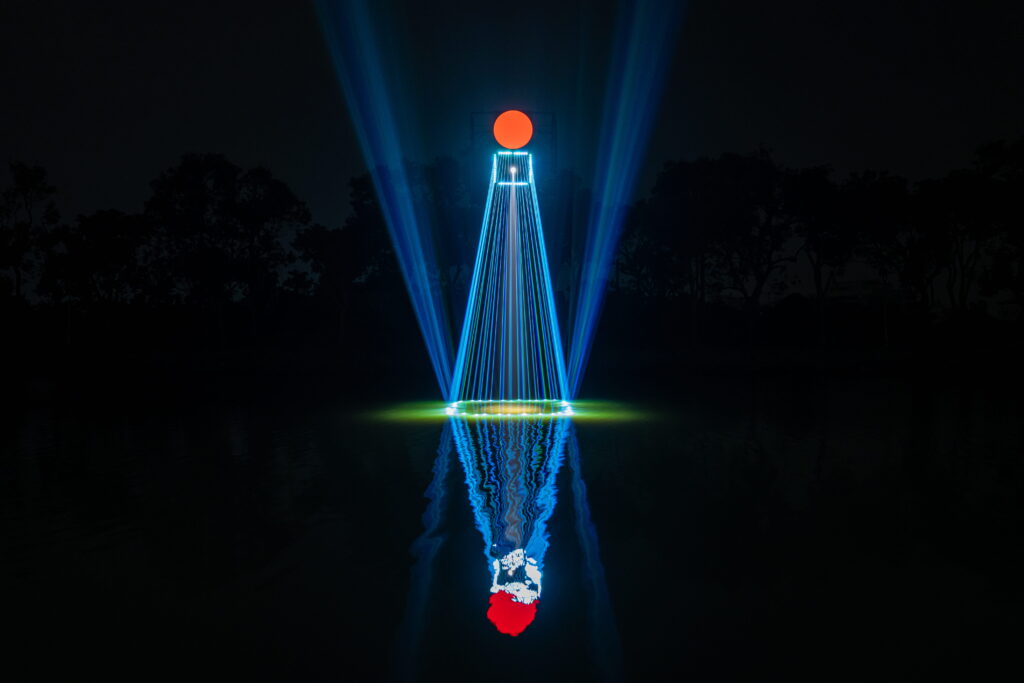
„Multimmersion: Upside Down v2“ / 2026 / Photo provide by Yujin Light Art Festival
You are an artist who specializes in using light to create spectacular scenes. How did somebody even start thinking about light as a primary artistic objective? Do you remember when you started thinking about playing with light? What helped you develop this process?
我從 2006年開始以 VJ 的角色開啟視覺藝術生涯,08年時全世界開始風靡 projection mapping 的風潮,那對我有很大的影響。在那個時期我常在思考把光影mapping到所有的物件或空間中的可能,為了要讓影像能覆蓋到任何3d環境、物件的表面,你其實已具備了控制光線到達空間中任何位置的能力。接著我開始思考 projection mapping 的下一步會是什麼,如果光源到達成像面之間這段光線能夠有效地被辨識、控制,並進而透過陣列化或透過介質改變光的形體。
I started my career in visual art as a VJ in 2006. Around 2008, projection mapping started becoming popular around the world, and that had a big influence on me. At that time, I was constantly thinking about the possibilities of mapping visuals onto different objects and spaces.
To make a video cover the surface of any 3D environment or object, you actually need the ability to precisely control where the light reaches in space. From there, I started thinking about what could come after projection mapping. What if the light between the source and the surface could also become visible and controllable? And what if I could further change the form of that light by arranging multiple light sources together, or by introducing different materials into its path?

„RING: Kosmogia“ / 2024 / Photo provided by National Taichung Theater
On your website, we can find the following: “As he grew older, it became apparent to him that even the most complex and dazzling images could be reduced to a single light source.” This led you to experiment with various luminous materials and smoke. Can you tell us more about these experiments and about this realization?
對我來說 VJ表現的是圖像,而 Projection Mapping 則是將動態的圖像結構化,從圖像到結構的過程就是一種簡化。再複雜的圖像極簡化到最小單位是一個pixel、是一個色塊,然而透過任何的螢幕、投影成像其實就是一個發光源。這樣的理解驅使我的藝術實踐朝向其他的發光媒介,它們通常能夠在空間中形塑所謂的solid light,如LED、光束電腦燈、以及雷射。
當圖像簡化至光,它就不再只侷限在螢幕的框架裡,它不再因為傳遞訊息的功用而被清楚辨識,取而代之的是能夠以更抽象,更具有流動性的形體去和空間、以及空間中的人事物建立關係。
For me, VJing was mainly about images, while projection mapping was about giving those moving images a structure. The transition from image to structure was already a process of simplification. If you reduce even the most complex image to its smallest unit, it becomes a pixel, a block of color. And whether it is shown through a screen or a projector, what we are actually seeing is light.
This realization pushed my practice toward other light-based media, especially those that can create what we call “solid light” in space, such as LEDs, moving head beam lights, and lasers. When an image is reduced to light, it is no longer limited by the frame of a screen. It also no longer needs to be clearly recognized as an image carrying information. Instead, light can become something more abstract and fluid, allowing it to build relationships with the space, the people within it, and everything around them.
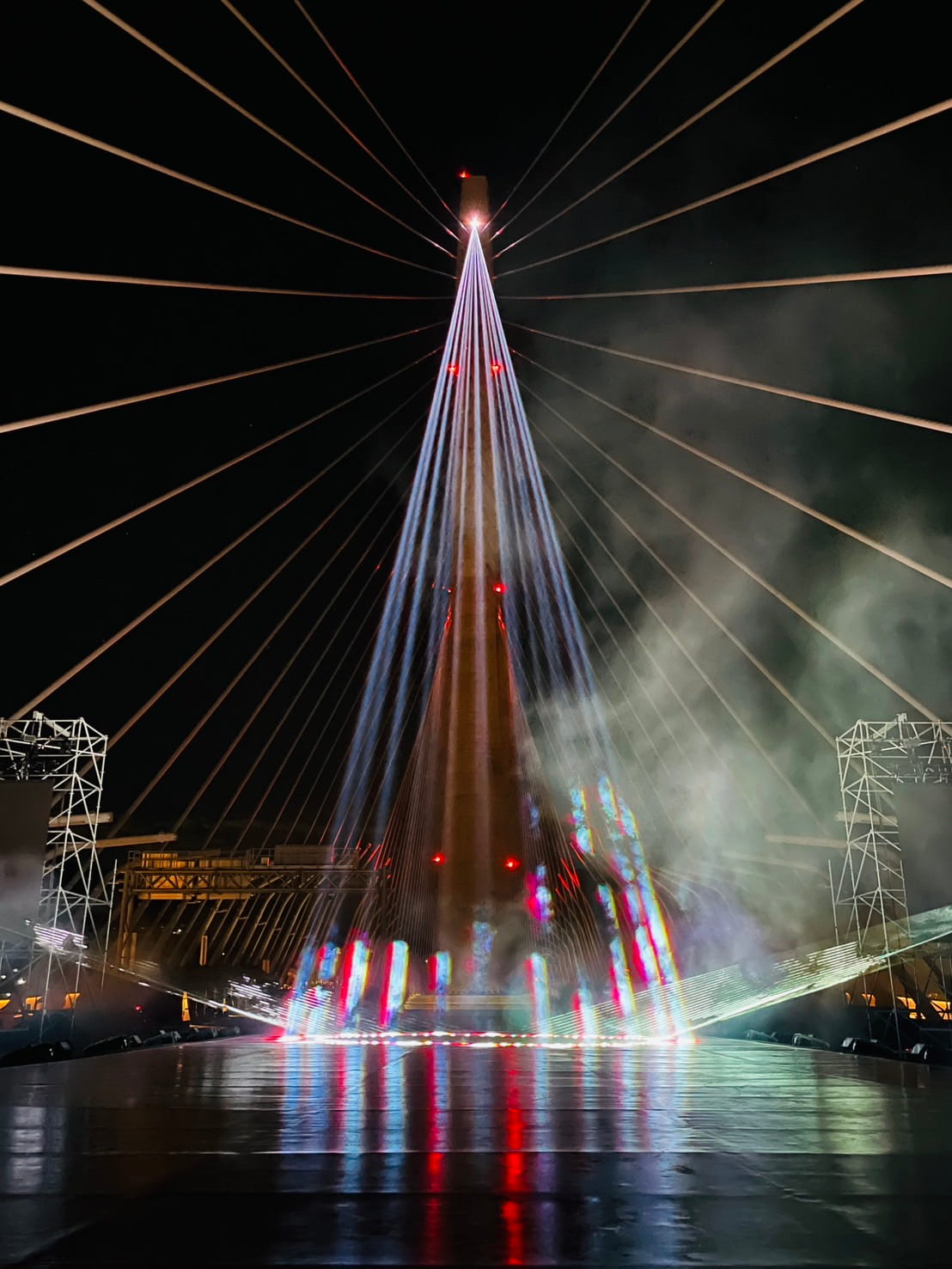
„Light Link“ / 2026 / Photo provide by Cloud Gate
You work a lot with symmetrical/asymmetrical patterns. Did you study mathematics and geometry so you could implement more detailed concepts in your artworks?
我總是欣賞數學幾何所代表絕對的美麗,我也喜歡質數那種單純也孤獨的存在。我很常運用一些基礎的幾何元素,像是圓形、方形,三角形等等,再賦予它們一些簡單的動態參數,譬如加減可以代表移動,乘除則代表縮放,然後再重組、排列它們。
I’ve always been fascinated by the absolute beauty of mathematics and geometry. I also like the simplicity and solitude of prime numbers. In my work, I often use basic geometric elements such as circles, squares, and triangles, and give them simple parameters for movement and transformation. For example, addition and subtraction can shift an element’s position, while multiplication and division can control its scale. I then rearrange, repeat, and combine these elements to create different structures.
Did you find some artists particularly interesting and important to you? In your early days or now, in recent times? Do you find inspiration in art history?
坂本龍一和 Alva Noto 的
V.I.R.U.S系列。
安藤忠雄和 James Turrell 在直到家計劃中的南寺。
Alexander Mcqueen 在1999年秋冬秀的最後一個piece。
AntiVJ 所有人的作品。
Ryuichi Sakamoto and Alva Noto’s V.I.R.U.S. series. James Turrell’s Backside of the Moon at Minamidera, designed by Tadao Ando as part of the Art House Project in Naoshima. The finale of Alexander McQueen’s No. 13, Spring/Summer 1999 show. All the works by the artists of AntiVJ.
In what aspects can nature be an inspiration for you? I’ve noticed you work a lot with water. Wind is also an element you work with naturally.
在我的作品裡會和自然元素產生關係主要還是因為雷射光這個特別的材料,它在一個極小的量體之內蘊含了強大的光能量,所以它特別適合和其他自然或人造的介質交互作用,呈現某些不常見的物理現象。
也因爲大自然環境的有機性、不可控制性,這都讓作品多了一份不可預測性,並且總是帶給我驚奇。譬如有一次用在高緯度地區的戶外河道上用雷射光投射一個圓形,夜晚水面上的霧氣讓光像是在流動、像是一個發出紅光的溫泉湖。透過自然元素改變光的形態,是我持續進行的藝術實踐之一,我希望接下來有機會帶著雷射這個當代的人造光源去到沙漠區域進行實驗和創作。
In my work, my relationship with natural elements mainly comes from laser light itself as a unique material. A laser contains a highly concentrated amount of light energy within a very small beam, which makes it particularly interesting when it interacts with other natural or artificial materials, sometimes revealing unusual physical phenomena. At the same time, natural environments are organic and impossible to fully control. This brings a certain unpredictability into the work, and it often surprises me. For example, I once projected a circle with laser light onto an outdoor river in a high-latitude region. At night, the mist above the water made the light seem to flow, almost like a hot spring glowing red. Changing the form of light through natural elements has become an ongoing part of my practice. In the future, I hope to take laser—this very contemporary, artificial source of light—into a desert environment and experiment with what might happen there.
On your website, there is a sentence: “Currently, his art represents an ongoing process of reduction.” This is interesting. Could you expand more on this?
如果大致描述我的創作邏輯可能會是像這樣。「把事物極簡到最小,再複製它、擴大它的規模」,或是「在有限的條件或規則之內,表現最多變化、最豐富的姿態。」我想簡約、節制都會是我現階段在創作過程中秉持的原則。
If I were to roughly describe the logic behind my practice, it might be something like this: “Reduce something to its simplest form, then repeat it and expand its scale,” or “Within a limited set of conditions or rules, explore as many variations and possibilities as possible.” I think simplicity and restraint are two principles that I try to maintain in my creative process at this stage.
Please tell us more about your relationship with music. What music do you enjoy, and how do you implement music into your performances and installations? Do you always collaborate with different producers/composers?
如我提到過的,我是以一個VJ的角色進入到視覺藝術的領域,音樂是我生涯中最不可或缺的存在。我相信對於音樂的閱讀和想像乃至對於聲音的感知都讓我的生命增添了不同的層次,也在我的創作中留下特別的氣息,而且我感覺具有這樣特質的人會彼此吸引,我遇過很多聯繫我的策展人或是藝術總監都曾經或具備地下音樂的背景,也有很多音樂家對我提出合作邀請,我感到感謝,也覺得很特別有趣。每個時期聽的音樂都不太一樣。這幾年我很常聽一些介於modern composition 、ambient 和 experimental electronic 之間的音樂。像是 Erased Tapes Records 或 Gondwana Records 發行的作品,另外在我需要專注時我也很常聽 NOTON 發行的作品,更極簡的電子音樂。
As I mentioned earlier, I entered the field of visual art as a VJ, so music has always been an essential part of my life and career. I believe that the way I listen to and imagine music, and even the way I perceive sound, has added different layers to my life and also left a particular quality in my work.
I also feel that people who share this kind of sensitivity tend to find each other. Many curators and artistic directors who have contacted me over the years have had some connection to underground music culture, and I’ve also received many invitations to collaborate from musicians. I’m grateful for that, and I find this connection very interesting. What I listen to changes over time. In recent years, I’ve been listening to a lot of modern composition, ambient, and more listening-oriented electronic music, including releases from labels like Erased Tapes Records and Gondwana Records. I also often listen to releases from NOTON when I need to concentrate.
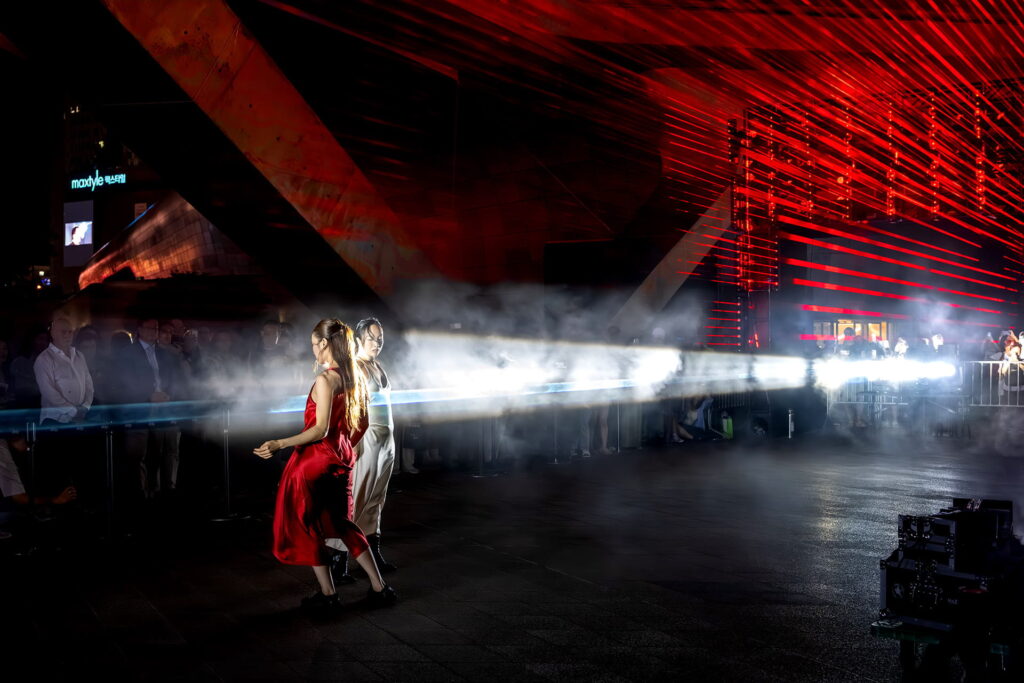
Participated in Seoul Light DDP 2025, at Seoul, Korea / Multimmersion: DDP25 / 2025 / Photo provide by Seoul Light DDP
What would you tell young and up-and-coming artists trying to find their voice and produce original, stunning work? Maybe what advice would you tell your past self?
我想告訴年輕的自己或是年輕的創作者相信自己。
在發想一個計劃時,相信自己的idea,並且開始實驗、製作。當計劃卡關時,相信自己能解決問題,並且持續進行。而在計劃進行到一半時,相信自己能做到,並且繼續完成它。
維持某種適合你的生活紀律、創作紀律。維持健康,把自己照顧好,生活就是創作,創作反映你的生命。
如果碰到某些機緣巧合的條件下,試著嘗試體驗迷幻藥的旅程。
I think what I would tell my younger self, or any young artist, is simply to trust yourself.
When you come up with an idea, trust it, and start experimenting and making. When you get stuck, trust that you can find a way through and keep going. And when you’re halfway through a project, trust that you can make it happen, and finish it.
Find a certain discipline in life and in your practice that works for you. Stay healthy and take care of yourself. Life is part of the creative process, and what you create reflects the life you live. And if the right opportunity and circumstances come along, maybe try a psychedelic experience.
_
✱ Interview: Krištof Budke / You can follow aka_chang on Instagram or website Profile photo: Grey Area for PURE G (2022). Photographer: Ray Zhao 趙翊睿 ✱
Pridaj komentár