
[La versión original en castellano se encuentra más abajo en el artículo]
Krištof Budke: On 26 November, I’m organizing a new event of Latin Core Thursdays for Prague’s club Fuchs2. In this space, for a local audience, I want to showcase some of the most innovative and creative artists from the incredible web of underground scenes across many countries in Latin America. From dedicated communities in (not only) cities like Bogotá, Caracas, Santiago, San Juan, Buenos Aires, São Paulo, Brasília, and others, through SoundCloud songs, playlists, and mixes, across the world to Central Europe. We are excited to bring from Mexico City, for the first time in the Czech Republic, Addly Muff, one of the co-founders and pioneers of the collective & label NACA Worldwide. I leave it here for my friend Ari (Gatita Tribalera), who was kind enough to do an intimate and insightful interview with Addly.
Here you can find the tickets to the Fuchs2 event.
Gatita Tribalera: They say real music isn’t born out of comfort, but out of urgency, out of the pressing need to hack pain, the periphery, and the margins to build a world of our own where both our fury and our tenderness belong.
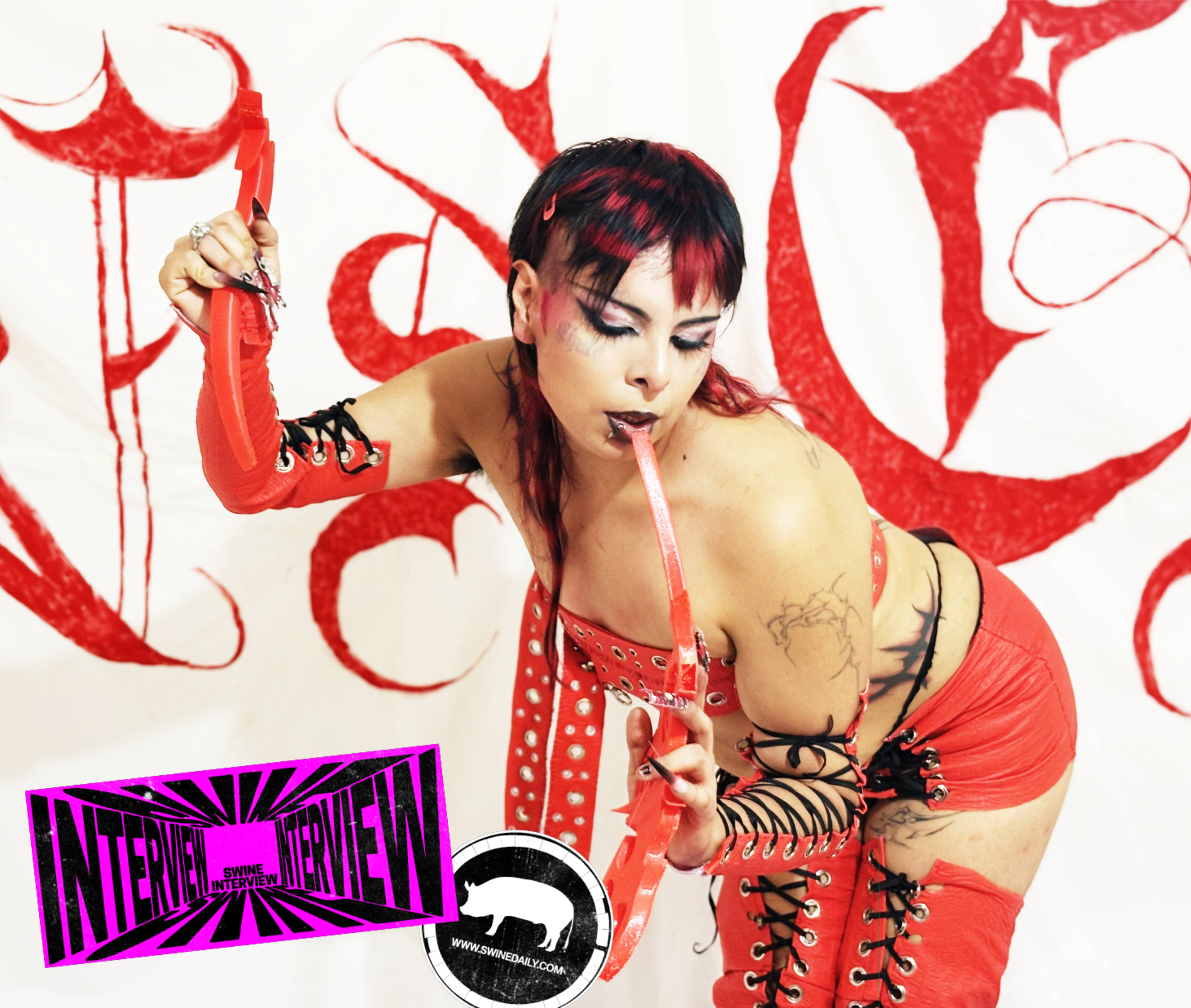
Addly Muff isn’t just a name on the flyers of the heaviest clubs, or a producer blowing out speakers with altars of tribal, gabber, and deconstructed club; Addly is a walking manifesto. A f*ggot, vampire, transsexual born in Edomex (State of Mexico), her work, from her album Furia trans to every stomp of her heels on stage, is a love letter to her inner little girl and a battle cry against an industry that usually looks the other way.
Today, Gatita Tribalera sits down with Addly from the trenches to the studio, to talk about scars, death as a companion, aesthetics as armor, and what it truly means to devour the world when you were told you weren’t made to walk upon it.
Addly, looking at your entire journey, from being a little kid spending time in hospitals and discovering music as a refuge, to cutting your teeth in hostile bands in Edomex, I feel like your music carries a very intense physical urgency. You started out playing in bands and conducting ensembles, and now you move through the club and tribal scenes. You’ve mentioned how hard it was at first to haul yourself from Edomex to Mexico City without knowing anyone or having any social capital. What was the exact moment you said, „This is why I do what I do, I’ve finally broken the barrier of the periphery,“ and felt that your sound was finally resonating in places that once seemed unreachable?
When my music started getting played at parties. Sometimes it was exact moments, like when Tayhana played at La Utopía in the State of Mexico, and other times it was random moments when I’d show up somewhere, not even knowing who was DJing, and suddenly hear one of my tracks. Those were really powerful realizations at the time. I never thought I’d get to hear one of my songs on a massive sound system at a venue, making so many people dance.
You talk about how death looked out for you and gave you the courage to transition. How does all that life force and survival translate when you’re building a track or stepping into the booth?
By reclaiming the sound and transgressing the space. It’s my offering to the path one has to walk to make it here. It’s not easy, nor is it fair or equal to the space a cis dude might occupy, showing up to the booth in sneakers and shorts. Something that is crystal clear to me before any creative process is that I haven’t just earned the space; I’ve survived to get there. And it’s my duty to honor every moment, emotion, and space I’m willing to explore.
When you first started seeing role models like Bruja Prieta or Neurokill on stage, what did you tell yourself to keep from throwing in the towel while the industry was still full of dudes and closed doors?
By being a fierce, relentless bitch. A lot of the opportunities that come your way don’t just appear out of nowhere; they are places and spaces you have to claim. And by making my music my top priority, there is nothing more important in my life than my music. I used to treat my music and where I wanted to take it as if it were my children.
And how did it feel when you started collaborating closely with the very people who inspired you from the start?
It’s a full-circle moment. I believe that the union of bodies creates power, and when I have the privilege of collaborating, being on the same lineup, or becoming friends with people I admire, I don’t just learn from them. I see hope and a breath of faith along the path, in an industry that can sometimes be very cruel to us.
You define yourself as ambitious and hungry by birth, because this country has taken so much away from trans girls. What does „winning the game“ of music mean to you today, and what goals do you have for the near future?
For me, it means the world. I don’t think I ever imagined I could make it this far. Obviously, it was always the dream, but being able to reach another continent just gives me even more reasons to always have more music to give in this reality.
In your songs and your interviews, you talk about honoring that effeminate little girl inside, with crooked hands and ballet pointe shoes, protecting her with a sword and shield. How do you translate that protection and body memory into your visual aesthetic? Do you feel that dressing up and putting yourself out there on stage is also a way of exorcising the past and reclaiming space? How do you use clothing, makeup, and your physical presence to mark your territory?
It’s a huge part of my presentation, because every outfit I wear and every concept I bring is something I make myself from scratch. It had always been my dream to step onto a stage and look like a star, and from the very beginning I realized it would be much cheaper, and consequently the result would be much more honest, if I took charge of my own image. And that’s how it’s been to this day. Every look I wear takes hours of preparation. My reference is always looking like the final boss in a video game, the one where you have to leave everything on the table just to beat them. And I like bringing that exact same energy to the dancefloor, making it a total battle experience.
You talk about death watching over you and carrying its ink on your skin. How do danger, surviving in the periphery, and beauty interact in the way you create this visual persona called Addly Muff? And why „Addly Muff“?
Being from the periphery is always going to be my biggest flex and my greatest pride, because while the girls in the city have resources right around the corner to access whenever they want, I have to make a journey that isn’t just financial; it’s also costly and emotional. And that also constantly motivates me: if other bitches show up at 100%, I show up at 1000%. „Addly“ comes from a blank piece of paper and putting letters together to form a word that could describe me, and „Muff“ comes from the Big Muff pedal that I’ve always wanted and which I hope to finally buy after this tour.
Coming from Edomex, where precarity is often in excess and resources are scarce, visual creativity from the periphery has always had to be hyper-resourceful, punk, and sharp. How do you make sure your aesthetic acts as a battle cry against gentrification and the bougie („fresa“) aestheticization of the capital’s clubs?
100% through my artistic vision. Honestly, I feel grateful to know, with certainty, what my artistic vision is, what my signature sound is, and what my references are for my image. Still, I feel like in moments where everyone is following a certain mold in the club, we can feel intimidated by the obvious difference we sometimes bring into the space. In those cases, I always try to stay honest to my true essence and never alter, modify, or change it for the venue, the situation, or the people surrounding it.
To close, Addly… If you could look back at that little girl sitting there watching Vive Latino in 2007, feeling the static of the TV, or commuting two hours from Edomex into a Mexico City that back then felt like a forbidden planet… what would you whisper in her ear today? And for the hundreds of trans girls and queer dissidents locked in their bedrooms in the periphery right now, staring at their Ableton folders and dreaming of setting the dancefloor on fire: what is the spell or the advice so they never drop their sword and shield?
I would tell them that the superpower the people you admire have—making hundreds of people dance right in front of you—is something you can do too, and it’s bigger than you think. The path isn’t going to be easy, especially not the first few years, but the gift that perseverance, patience, and constant work will give you won’t just be music that changes lives and clubs dancing to the rhythm of your dreams; wonderful people will also come into your life along the way.
La versión original en castellano →
Dicen que la música verdadera no nace de la comodidad, sino de la urgencia; de la necesidad imperiosa de hackear el dolor, la periferia y los márgenes para construir un mundo propio donde quepa nuestra furia y nuestra ternura.
Addly Muff no es solo un nombre en los flyers de los clubes más pesados o una productora que rompe bocinas con altares de tribal, gabber y deconstructed club; Addly es un manifiesto andante. Jotita, vampira, transexual nacida en el Edomex, su obra, desde su disco Furia trans hasta cada taconazo que da en la tarima, es una carta de amor a su niña interior y un grito de guerra contra una industria que suele mirar hacia otro lado.
Hoy Gatita Tribalera se sienta con Addly Muff, desde la trinchera al estudio, para hablar de cicatrices, de la muerte como compañera, de la estética como armadura y de lo que significa, de verdad, comerse el mundo cuando te dijeron que no estabas hecha para pisarlo.
Addly, viendo todo tu recorrido, desde morrita pasando por hospitales y descubriendo la música como un refugio, hasta foguearte en las bandas hostiles del Edomex, siento que tu música tiene una urgencia física muy cabrona. Empezaste tocando en bandas y dirigiendo ensambles, y ahora te mueves en el club, en el tribal.
Mencionas lo pesado que era al principio jalar desde el Edomex a la CDMX sin conocer a nadie ni tener capital social. ¿Cuál fue el momento exacto en el que dijiste por esto hago lo que hago, ya rompí la barrera de la periferia y sentiste que tu sonido por fin estaba resonando donde te parecía inalcanzable en ese momento?
Cuando mi música empezaba a sonar en las fiestas. A veces eran momentos exactos, como cuando Tayhana tocó en La Utopía en el Estado de México, y otras veces momentos random en los que yo, sin conocer a quien estuviera tocando, llegaba a escuchar una canción mía. Eran realizaciones muy fuertes; en el momento jamás pensé en llegar a escuchar una canción mía en un sonido grande, en un venue, haciendo bailar a tantas personas.
Hablas de cómo la muerte te cuidó y te dio valor al transicionar. ¿Cómo se traduce toda esa potencia de vida y de supervivencia cuando estás construyendo un track o cuando te subes a la cabina?
Reclamando el sonido y transgrediendo el espacio. Es mi ofrenda al camino que una recorre para poder llegar hasta aquí. No es fácil, ni justo, ni equiparable al lugar que podría ocupar un vato cis que llega con tenis y shorts a la cabina. Algo que me queda claro antes de cualquier proceso creativo es que el espacio no solo me lo he ganado, sino que he sobrevivido para poder llegar hasta ahí; y es mi deber honrar cada momento, emoción y espacio que esté dispuesta a explorar.
Cuando empezaste a ver a referentes como Bruja Prieta o Neuro Kill en los escenarios, ¿qué te decías a ti misma para no soltar la toalla cuando la industria seguía llena de vatos y de puertas cerradas?
Siendo perra y aferrada. Muchas de las oportunidades que a veces llegan no surgen de la nada: son sitios y espacios que una tiene que reclamar. Y poniendo como prioridad mi música; no hay cosa más importante en mi vida que mi música. Yo decía, mi música y a dónde quiero llevarla, como si se tratara de mis hijxs.
¿Y cómo te sentiste cuando empezaste a colaborar de cerca con aquellas personas que te inspiraron desde el principio?
Es un círculo completo. Creo que la unión de cuerpos hace la potencia, y cuando tengo el privilegio de poder colaborar, estar en el mismo lineup o ser amiga de personas que admiro, no solo aprendo de ellas, sino que veo una esperanza y un aliento de fe en el camino y en esta industria que a veces puede ser muy cruel con nosotras.
Te defines como una persona ambiciosa y hambriada de nacimiento, porque a las morras trans este país les ha quitado mucho. ¿Qué significa hoy en día para ti ganar el juego de la música y qué metas traes para el futuro próximo?
Para mí lo es todo; creo que jamás había imaginado que pudiera llegar tan lejos. Obvio siempre fue el sueño, pero el poder llegar a otro continente solo me da más razones por las cuales siempre tendré más música para poder dar en esta realidad.
En tus canciones y en tu discurso hablas de honrar a esa niña interior afeminada, con las manos torcidas y zapatillas de punta, protegiéndola con espada y escudo. ¿Cómo trasladas esa protección y esa memoria corporal a tu estética visual?
¿Sientes que vestirte y exponerte en la tarima es también una forma de exorcizar el pasado y reclamar el espacio? ¿Cómo usas la ropa, el maquillaje y tu presencia física para marcar territorio?
Es una parte muy importante de mi presentación, ya que cada vestuario que tengo y cada propuesta que llevo es algo que armo desde cero. Siempre había sido mi sueño poder llegar a un escenario y verme como una estrella, pero desde el inicio me di cuenta de que sería mucho más barato, y el resultado por consecuencia sería mucho más honesto, si yo me encargaba de mi propia imagen, y así ha sido hasta la fecha. Cada look que llevo lleva horas de preparación; mi referencia siempre es verme como el último jefe final de un videojuego, en el cual tienes que dejarlo todo en la pantalla para poder vencerlo. Y esa misma energía me gusta trasladarla a la pista de baile, para que sea una completa experiencia de batalla.
Hablas de que la muerte te cuida y que llevas su tinta en la piel. ¿Cómo dialogan el peligro, la supervivencia en la periferia y la belleza en tu forma de crear este personaje visual llamado Addly Muff? ¿Y por qué Addly Muff?
El ser de la periferia siempre va a ser mi mayor flex y mi mayor orgullo, porque mientras las de la ciudad tienen los recursos a la vuelta de la esquina para acceder a ellos, yo tengo que hacer un traslado que no solo implica tiempo y dinero, sino un desgaste emocional tremendo. Y eso constantemente me motiva, si las demás llegan a un 100 por ciento, yo llego al 1000 por ciento.
Addly nace de un papel en blanco y de una conjugación de palabras que pudiera describirme; y lo de Muff viene del pedal de distorsión Big Muff, que siempre he querido y que espero poder comprar después de esta gira.
Viniendo del Edomex, donde muchas veces lo que sobra es precariedad y lo que falta son recursos, la creatividad visual de la periferia siempre ha tenido que ser hiperingeniosa, punky y afilada. ¿Cómo le haces para que tu estética sea un grito de guerra contra la gentrificación y la estetización fresa de los clubes de la capital?
Ciento por ciento a través de mi propuesta. La verdad, me siento muy agradecida de poder saber con certeza cuál es mi visión artística, cuál es mi sonido identitario y cuáles son las referencias que tengo respecto a mi imagen. Siento que en momentos en los que todo el mundo sigue una misma línea en el club, una se puede llegar a sentir intimidada por la diferencia evidente que a veces causamos en el espacio; entonces, en esos casos, siempre intento ser honesta con lo que es mi verdadera esencia, y no alterarla, modificarla o cambiarla por el lugar, la situación o las personas de quienes esté rodeada.
Para cerrar, Addly… Si miraras atrás, a esa morrita sentada viendo el Vive Latino en 2007, sintiendo la estática de la tele, o cruzando dos horas desde el Edomex hacia una CDMX que entonces parecía un planeta prohibido… ¿Qué le dirías hoy al oído a esa niña? Y para los cientos de morras, trans y disidencias que están encerradas en su cuarto en la periferia ahorita mismo, viendo sus carpetas de Ableton y soñando con incendiar la pista, ¿cuál es el conjuro o el consejo para que nunca suelten la espada y el escudo?
Les diría que ese superpoder que tienen las personas que admiras, el de hacer bailar a cientos de espectadores frente a ti, tú también lo posees, y es más grande de lo que te imaginas. El camino no va a ser fácil, ni mucho menos los primeros años, pero el regalo que te dará la perseverancia, la paciencia y el trabajo constante no será solo música que cambiará vidas y clubes que bailarán al ritmo de tus sueños; también llegarán personas maravillosas a este camino.
–
✦ Interview (Entrevista): Ari (aka Gatita Tribalera) / You can follow Addly Muff on Instagram or SoundCloud / Collective NACA here and be sure to come to Latin Core Thursday at Fuchs2, Prague ✦
Pridaj komentár