
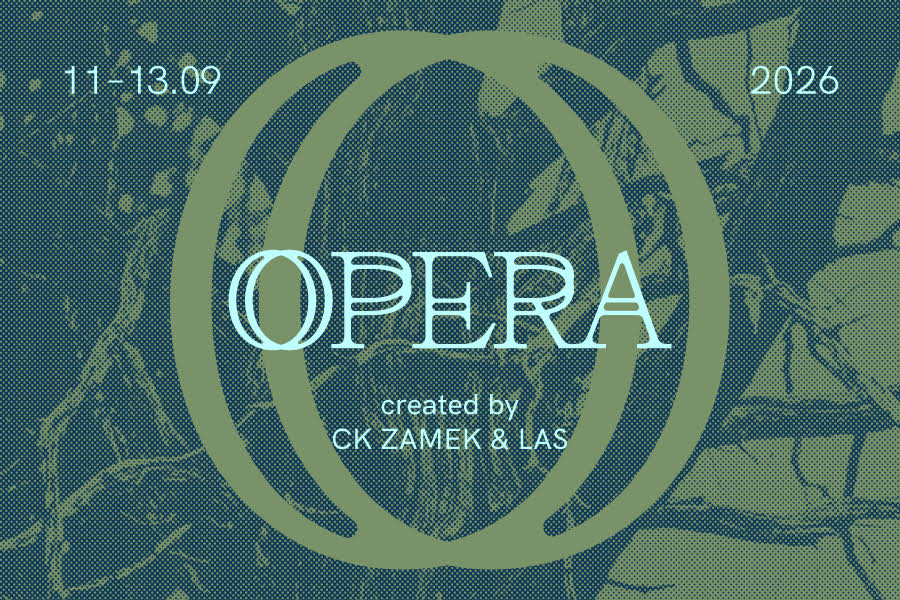
From 11–13 September, Poznań will host the third edition of OPERA — a festival of contemporary experimental and electronic music that approaches sound as a way of understanding the present. Organised jointly by Centrum Kultury ZAMEK and the independent promoter LAS, the festival returns with a programme that moves between post-club music, improvisation, drone, extreme sound design and more recognisable forms of contemporary music. But perhaps the most useful way to understand OPERA is not through a list of genres, but through the words of its directors. They describe the festival as “the soundscape of the 21st century. Its weaknesses, anxieties, challenges. Its unnatural pace of change, development and hope.”
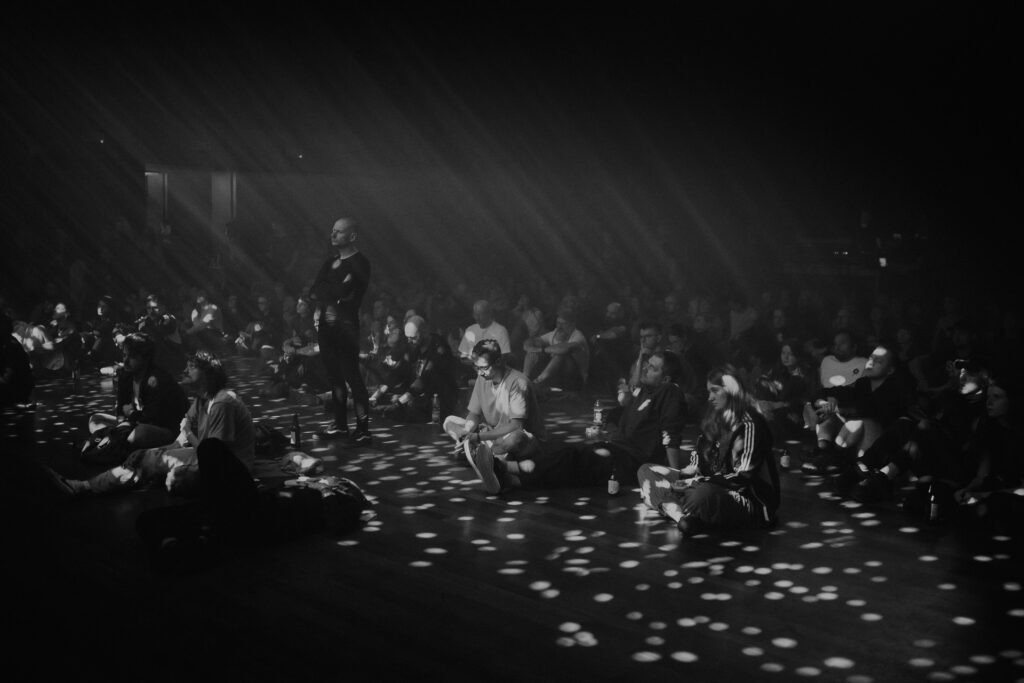
Opera 2025
It is a description that places the festival somewhere between a concert programme and a way of listening to the world around us. OPERA is interested in music that can be delicate, immersive and absorbing, music that demands concentration — but also in the energetic, furious side of post-club DJ sets. The point is not to choose between these two extremes, but to allow them to exist within the same musical landscape.
Not Just Another Experimental Music Festival
Festivals such as Unsound, CTM or Atonal have one thing in common: they are interesting not only because of the individual artists they present, but because of how those artists are placed next to one another. OPERA operates in a similar way.
There is no sense here of simply collecting a few big names, adding several local artists and distributing them across stages. Instead, the programme is built around sequence and composition. The emphasis is not on quantity, but on the carefully considered order and arrangement of events, allowing each musical thread to be experienced more deeply.
This distinction matters. Experimental music rarely needs to be constantly explained. But it does need good context. When a sharp, physically intense club set is followed by music concerned with silence, duration or timbral detail, this is not merely a change of mood. It is a way of hearing each of those practices differently. OPERA offers precisely this kind of experience: not a competition between artists for attention, but several days in which music gradually reshapes the way you listen.
A Soundscape of the 21st Century
The directors’ description of OPERA is particularly revealing because it avoids treating experimental music as something detached from everyday life. The festival is not simply interested in new sounds for their own sake. It is interested in what those sounds can tell us about the conditions in which we live.
The 21st century is a strange musical environment. Everything moves faster, but that does not necessarily mean we experience more. Technology changes the way music is produced, distributed and consumed; the boundaries between club, concert, installation and online space continue to shift. At the same time, the world around us is marked by anxiety, political instability, exhaustion and an almost constant demand to keep up.
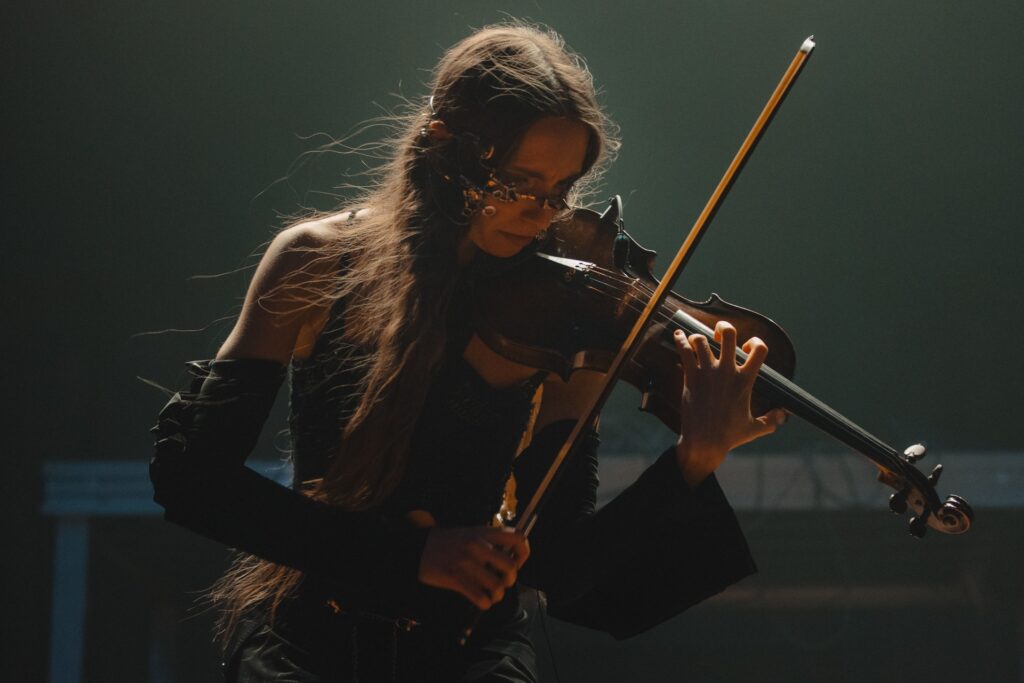
Katarina Gryvul, Opera 2025
OPERA’s programme seems to approach these conditions without trying to turn them into a single aesthetic statement. Some of the music is intimate and absorbing, asking for patience and concentration. Some of it is physical, aggressive and immediate. Some of it works through repetition, duration and subtle changes in texture. Others use rhythm, distortion or the voice as a way of confronting the body directly. The interesting part is that these approaches do not cancel one another out. They describe different ways of being in the same present.
What Makes the 2026 Programme Particularly Interesting
This year’s festival once again avoids obvious genre classification. There is music that can be described through the club scene, but also artists for whom the club is only one of several possible entry points into sound. Friday’s programme illustrates this approach particularly well. FOQL presents Bug Poems opens the festival with a project in which experimental electronics meet a more fluid, textural form of sonic expression. The programme then moves through Juli Deák, Dying Is The Internet with Abdullah Miniawy and Simo Cell, MOIN, and later ssaliva, emma dj and MAGMA — a collaboration between Piernikowski and Sienkiewicz.
This is not simply a collection of different genres. From one performance to the next, the very idea of what can constitute a “song”, a “performance” or “club music” begins to shift. The programme moves between forms that are recognisable and forms that resist easy description, without making that resistance the main point.
Saturday is perhaps even more revealing. schtum, Divide & Dissolve, aya and Slikback represent four very different musical positions, yet each works with the tension between body, voice, rhythm and sound. There is heaviness, but not necessarily in the conventional sense; there is aggression, but not necessarily as an effect.
This is music that can be physical, political, emotional or simply very strange — and all of those things at once. Sunday changes the perspective again. William Basinski is a name that has long become almost a genre of its own in conversations about contemporary music. His work with repetition, decay, memory and time does not need volume to be radical. Alongside him are Sam Slater, Theresa Baumgartner and Lukas Feigelfeld, presenting LUNNG. This is a different kind of musical attention: less concerned with impact and energy, and more with duration, space and the way sound alters our perception of time.
These transitions are precisely what make OPERA interesting. The festival does not try to prove that experimental music must necessarily be noise, distortion or complex electronics. It shows that experimentation can also happen in rhythm, in the voice, in minimalism, and in the very structure of a composition.
The Castle as Part of the Musical Experience
OPERA takes place at Centrum Kultury ZAMEK in Poznań — one of the city’s major cultural institutions, housed in a historic castle. This is not simply a convenient venue for the festival. The architecture becomes part of the experience. Instead of the familiar festival field or club environment, there are halls, corridors, courtyards, and different acoustic and visual conditions. The music is embedded in a place that already carries its own history, scale, and atmosphere.
This is particularly important for experimental music. When sound is not separated from the space in which it emerges, the experience of listening changes. The same artist can sound completely different in a club, a gallery or a large historic hall. OPERA uses this difference not as a decorative effect, but as part of its underlying logic. The castle also gives the festival a particular kind of tension. It is a historical building, but the music taking place inside it is often concerned with the present — with technologies, bodies, anxieties and forms that are still being invented. The result is not necessarily a contrast between old and new, but a meeting between different ideas of time.
Why It Is Worth Paying Attention To
OPERA is still a relatively young festival, but it already has a fairly clear position. It is not trying to become a Polish copy of Unsound, or another international festival built around a collection of big names. Rather, it offers its own perspective on contemporary experimental music — through careful selection, the architecture of the venue and an openness to different musical languages.
It is a festival for people who are interested not only in what is being played, but also in why exactly it is being played next to something else.
For those who enjoy music that does not always explain itself immediately. For those who value non-obvious lineups, where you can arrive for one artist and leave having discovered something entirely different. For those who see a festival not as a marathon between stages, but as an opportunity to spend several days changing the way they listen.
And perhaps this is what makes OPERA particularly interesting at this stage: it is still young enough not to be constrained by its own format, but already confident enough to understand that experimental music is not a separate genre, but a way of looking at music as a whole.
OPERA 2026
11–13 September 2026
Centrum Kultury ZAMEK, Poznań
🎟️ Three-day pass — 249 PLN.
Single-day tickets: 99 / 99 / 69 PLN.
Full programme and tickets — on the ZAMEK website.
Pridaj komentár