
I went to Poznań for the third edition of OPERA, a festival I had already experienced in its very first year. Even then, I had the feeling that there was something here with real potential – a very particular approach to experimental music, an ambitious setting, and a thoughtful, distinctive approach to selection and curation.
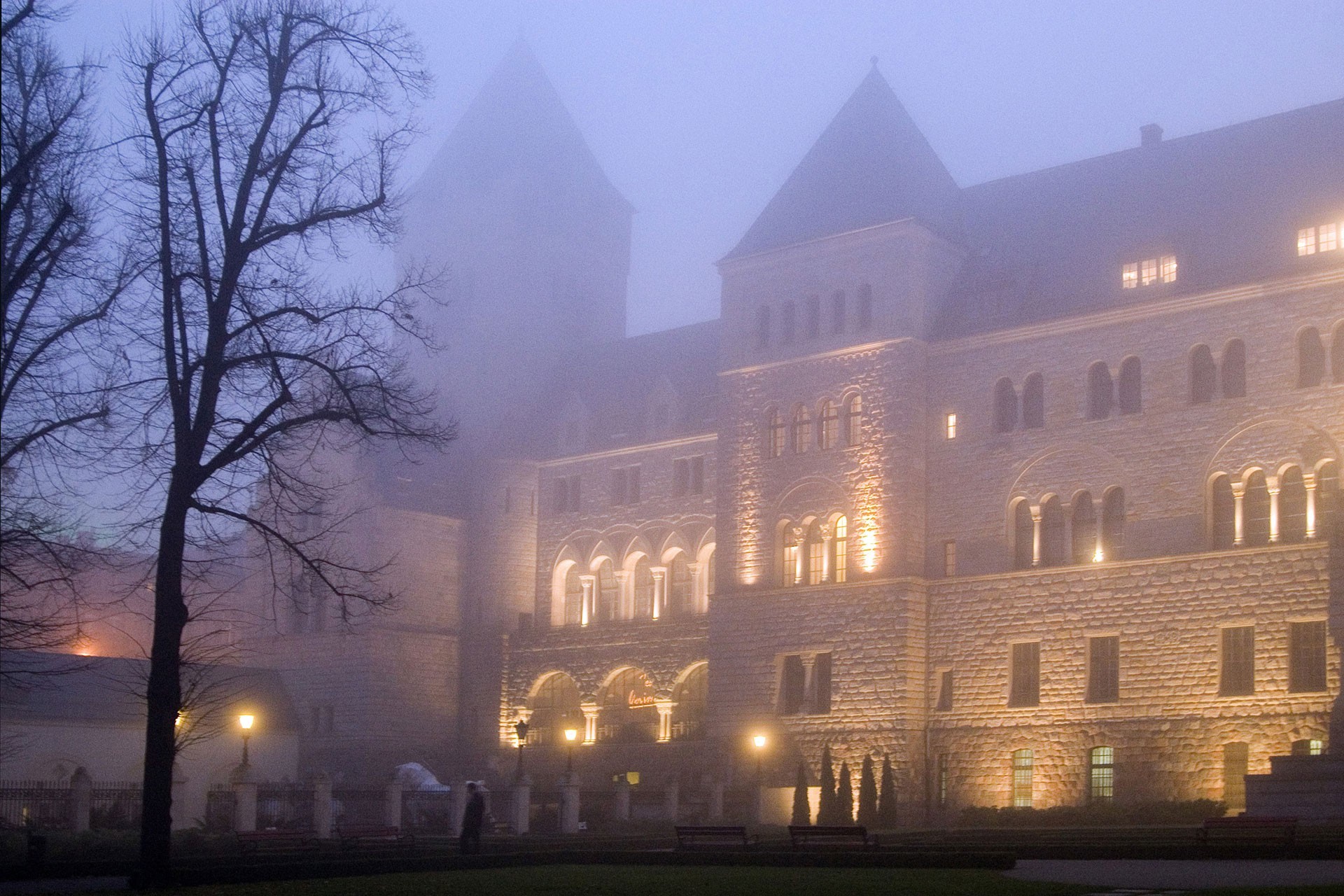
Coming back to the third edition, one of the first things that struck me again was the professionalism of the production. The festival takes place at CK ZAMEK, the monumental former Imperial Castle in the very centre of Poznań. The building had always intrigued me whenever I visited the city – partly because of its scale and Gothic character. Only later did I discover what a fascinating and open cultural space it actually is, one that welcomes contemporary and experimental forms of art and seems remarkably open to projects of this kind. OPERA makes exceptionally good use of it.
What particularly deserves to be highlighted is the technical side of the festival. The sound and lighting are not treated as secondary elements supporting the programme; they are fundamental to the experience. For experimental music, this matters enormously. When you are dealing with dense compositions, harsh textures, extreme dynamics, distortion, or sound that is deliberately overwhelming, the quality of the system can completely change the way the music is perceived. At OPERA, the sound was simply on another level.
The same goes for the lighting. There were moments when the visual environment did much more than simply illuminate the stage – it became part of the emotional architecture of the performance. The combination of the building, the acoustics, the sound system and the lighting created an unusually immersive environment, one that I would associate with festivals whose production teams have decades of experience behind them. And perhaps this is one of the things I appreciate most about OPERA: the ambition of the experience is much bigger than the festival’s physical scale might initially suggest.
There is also something remarkably considerate about the way the festival treats its audience. Free earplugs were available, posters could be taken home, the spaces were comfortable and easy to navigate, and there was a general feeling that the audience’s experience had genuinely been thought through. Nothing felt unnecessarily complicated. It is a simple thing, but it makes a huge difference during a festival built around such demanding music.The same care was apparent in the curation.
OPERA’s programme does not feel like a sequence of artists placed one after another. There is a sense of movement between performances – of being gradually led from one emotional and sonic state into another. The transitions are subtle, sometimes almost imperceptible. One performance prepares your ear for the next one, while still taking you somewhere unexpected. The result is a kind of sensitive, almost vulnerable form of curation: the festival gives you space to listen rather than constantly demanding your attention. And this year, what surprised me most was how deeply I responded to the music that existed outside what I would normally describe as electronic music.
Of course, there was plenty of experimental electronics, bass, post-club and more physically intense material – and much of it was excellent. But some of my strongest experiences came from sounds that moved towards shoegaze, doom metal, ambient music, live instrumentation and experimental composition. I was genuinely happy to discover that OPERA could give me this kind of sonic experience instead of simply reinforcing what I already know and listen to.
My absolute highlight was Divide and Dissolve. The Australian duo’s instrumental doom metal could, on paper, suggest something cold, severe, and impenetrable. Instead, what I experienced was almost the complete opposite. Their performance felt like an act of alchemy.
There was an incredible amount of heaviness, distortion, and intensity in the sound, but underneath it I could feel an extraordinary warmth. At times, the music gave me something closer to unconditional love, acceptance, and safety than aggression. It was almost a physical feeling – strangely reminiscent of being held, protected, even of the sensation of being inside a womb. And this is where the apparent contradiction became so powerful. Some passages were brutally dense and harsh, yet I found myself dissolving into them rather than resisting them. The heavier the sound became, the more vulnerable the experience felt.
What moved me most was the sense of sensitivity underneath the force. It never felt like heaviness for the sake of heaviness, or noise for the sake of impact. There was an extremely delicate emotional core inside the performance — a feeling that these two musicians were communicating something much more intimate than simply presenting a concert. I left feeling, quite literally, cleansed.
Moin was another performance I had been particularly looking forward to, largely because I had already experienced Valentina Magaletti live several times, but never as part of Moin. Magaletti – the drummer, percussionist and composer at the centre of so many experimental projects — is one of those musicians whose approach to rhythm feels less like accompaniment and more like a form of language. With Tom Halstead and Joe Andrews, she forms the trio Moin, whose music sits somewhere between experimental rock, post-punk, electronics and fractured rhythmic structures.
Live, the whole thing felt like one continuous piece rather than a collection of separate musical ideas. There were different vocal textures, radically different instrumental parts, shifts in density and rhythm, but everything seemed to belong to the same emotional world. The result was a kind of warm melancholy — not sadness in a conventional sense, but something much more pleasurable: the feeling of being suspended inside a beautiful, slightly distorted memory.
I was also very excited for Dying Is The Internet, the collaboration between Simo Cell and Abdullah Miniawy. Unfortunately, Miniawy was unable to make it at the last minute, leaving Simo Cell to navigate the situation on his own. And he absolutely did.
Simo Cell is one of the producers I consider to be at the top of the game, so even without the original setup, the performance remained musically strong and completely engaging. It moved through dubstep, bass and club music, but with that unmistakable Simo Cell twist – a playful, unconventional approach to rhythm and sound that constantly keeps you slightly off balance. I ended up dancing through most of it, which was probably the simplest and most accurate response I could have had. It was fun, physical and full of movement, while still retaining the experimental edge that made it feel completely at home within OPERA’s programme.
Then there was aya. I have heard aya live before, but somehow the effect remains just as immediate. There is something almost physically contagious about the energy of the performance. I find myself watching, listening and moving without consciously deciding to do any of it. The transitions, the violence and precision of the sound, the sheer unpredictability of it — my body simply responds. It is one of those performances where you stop being an observer for a while and become part of the movement of the music.
Slikback was another particularly meaningful performance for me. As a DJ, digger, and selector, he is one of my personal idols in electronic music. His productions have become such a natural part of the way I listen and play that it is hard to remember a recent set of mine that did not include one of his tracks. What made this particular performance especially satisfying was that he played a lot of his older material. This felt almost like a gift, considering how relentlessly active he is as a producer – constantly releasing new music, developing his sound and pushing himself into new territory. Hearing those older tracks in this context reminded me just how much ground his music has covered, while also bringing back the raw quality that made me fall in love with it in the first place.
It is always a pleasure to hear Slikback, but this set felt particularly generous. Familiar tracks suddenly felt different in that environment, and I found myself enjoying them not only as someone who follows his work closely, but simply as a listener who knows exactly how much energy and character there is in his music.
ssaliva was another artist I had been particularly curious to experience. His work has always had this strange quality of melancholic intimacy – music that feels simultaneously distant and deeply personal. His sound moves through ambient electronics, sparse rhythms, crystalline textures, and a kind of dreamlike, almost hypnagogic atmosphere.
Live, I found myself less interested in identifying exactly what I was hearing than in the emotional space it created. It felt like being somewhere between memory and sleep: familiar enough to trigger something emotional, but abstract enough that the feeling could not be reduced to a single story. And then there was Sam Slater and Theresa Baumgartner.
This was probably the performance that affected me most unexpectedly. Slater’s dense, distorted electronic composition was combined with Baumgartner’s monumental lighting and Lukas Feigelfeld‚s processed cinematic imagery, creating something much closer to a fully constructed audiovisual world than a conventional live set. By the end, I actually found myself close to tears.
There was something deeply cinematic about the whole experience, but not in the obvious, spectacular sense. It felt more like being pulled through fragments of memory — moments of intensity, disorientation, nostalgia, fear and beauty appearing and disappearing before I could fully grasp them. The sound could be abrasive and overwhelming, while the visual language gave it an almost dreamlike emotional dimension.
It was the kind of performance that reminded me why I still want to be surprised by music. And that, ultimately, is what I took away from OPERA this year: not simply a collection of good performances, but a reminder that experimental music can still take you somewhere you did not know you wanted to go.
–
Text: @veronicami
Pridaj komentár